Shantakaram Bhujagashayanam is Lord Vishnu’s best-known peace mantra. “Shantakaram” means “one whose form is peaceful”: Vishnu is always calm and steady-minded, whether he is praised or blamed. An old story about the sage Bhrigu shows why the mantra begins with that word.
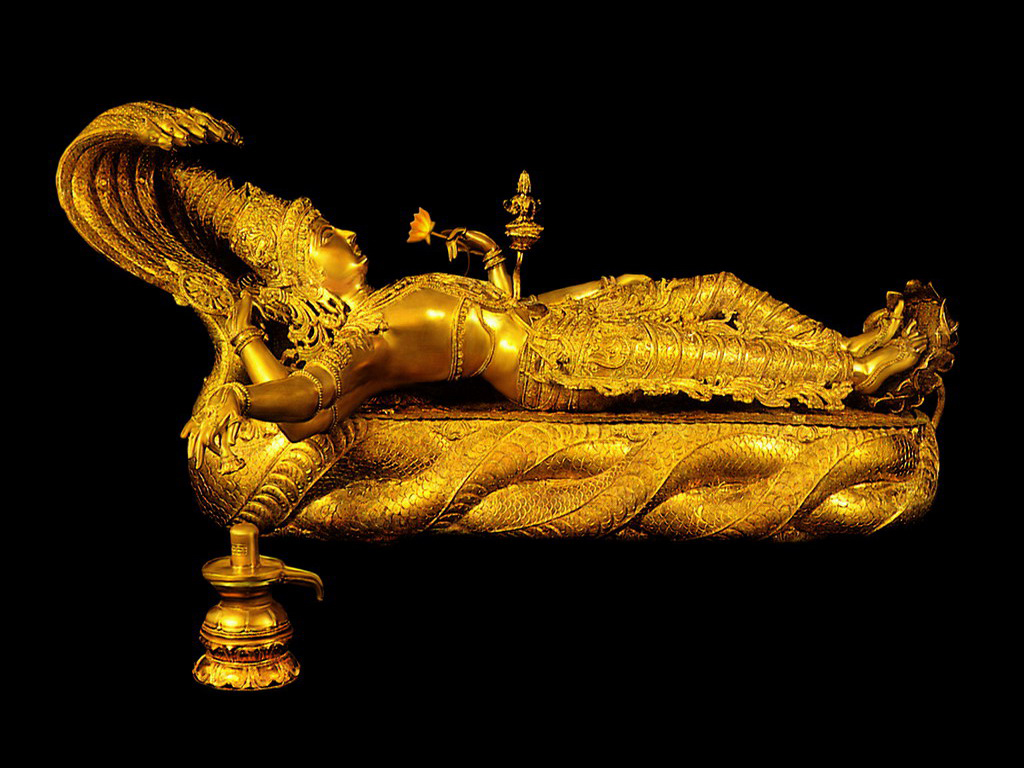
The Vishnu mantra: Shantakaram Bhujagashayanam
शान्ताकारं भुजगशयनं पद्मनाभं सुरेशं
विश्वाधारं गगनसदृशं मेघवर्णं शुभाङ्गम्।
लक्ष्मीकान्तं कमलनयनं योगिभिर्ध्यानगम्यम्
वन्दे विष्णुं भवभयहरं सर्वलोकैकनाथम्॥
Shantakaram bhujagashayanam padmanabham suresham, vishvadharam gagana-sadrisham megha-varnam shubhangam. Lakshmikantam kamala-nayanam yogibhir-dhyana-gamyam, vande Vishnum bhava-bhaya-haram sarva-lokaika-natham.
What is the meaning of Lord Vishnu’s mantra?
In plain words: “I bow to Lord Vishnu, the one master of all the worlds. He is ever peaceful, rests on the serpent Shesha, and the lotus of creation springs from his navel. He is the lord of the gods, the support of the universe, all-pervading like the sky, dark as a rain cloud, with a beautiful form. He is the beloved of Lakshmi, lotus-eyed, and yogis reach him through meditation. He removes the fear of worldly existence.”
Word by word: shantakaram is the peaceful form, bhujagashayanam is the one lying on a serpent, padmanabham is the one with a lotus in the navel, megha-varnam is cloud-coloured, lakshmikantam is Lakshmi’s beloved, and bhava-bhaya-haram is the remover of the fear of samsara. For more on the verse and its use in prayer, read Shantakaram Bhujagashayanam, the Vishnu mantra.
Who is the most peaceful of the gods? Sage Kashyapa’s yajna
Once Sage Kashyapa was performing a yajna and all the sages had gathered to witness it. A doubt arose in their minds: who is the highest of all the divinities?
Sage Narada replied that the Trinity, Brahma, Vishnu and Maheswara, were the highest, but Lord Vishnu was supreme. Neither praise nor blame ever disturbed him. He was ever peaceful and in bliss. The sages asked Narada to prove it. Narada called Sage Bhrigu aside and whispered something in his ear. Bhrigu was sent to test the truth of Narada’s statement.
Bhrigu criticises Brahma and Shiva
He first went to Brahmaloka. He saw Lord Brahma busy with his act of creation. From afar, Bhrigu started condemning him. He said, “Oh Brahma, you do not have the proper knowledge of creation! Your creation is full of defects and faults. Therefore all your efforts are in vain. Not a single thing in your creation is worth praising.” Lord Brahma was annoyed to hear these words. He got up from his seat and came forward to punish Bhrigu, but the sage ran away.
Then Bhrigu went to Shivaloka. He saw Lord Shiva engaged in the Tandava dance. From a distance Bhrigu began to criticise him: “Oh Shiva, you are not looking after your department properly. Your task is to destroy the evil of the world, but the world today is full of evil. You are busy dancing the whole day and are not doing the task allotted to you. Why should we worship you then?” Lord Shiva was angry to hear this and was about to open his third eye to burn the sage, but the sage ran away from there.
Bhrigu kicks Vishnu’s chest
Then he went to Vaikuntha. He saw Lord Vishnu resting upon Shesha. Bhrigu grew very angry, seeing that the Lord was not coming for his devotees but seemed engaged in self-enjoyment. He went near Lord Vishnu and kicked him hard on the chest.
Bhrigu was afraid of the consequences and was about to run away. But to his surprise he saw Lord Vishnu get up from his seat and fall at his feet. The Lord said, “Oh sage, please forgive me for not noticing you, which caused your anger to rise. My iron-like chest may have hurt your foot. Let me press it and comfort you.” What great tolerance! What a peaceful state! Bhrigu was taken aback and asked the Lord to forgive him.
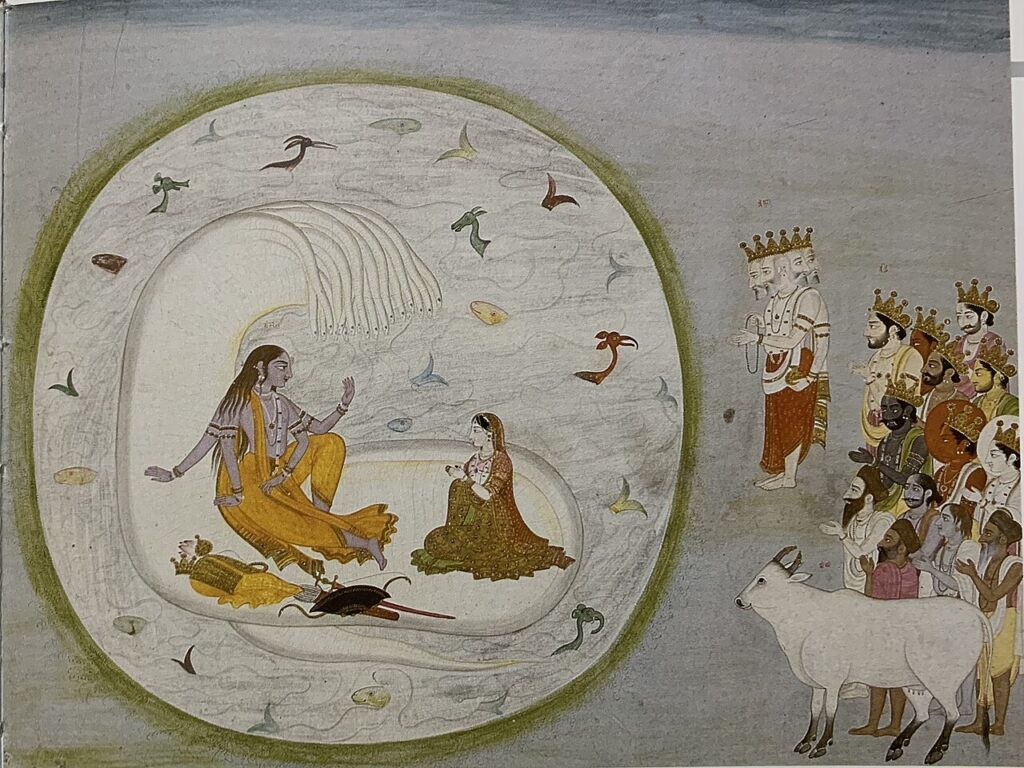

What the sages concluded
Then the sage came back to the council of the sages at the yajna and narrated the whole story. Hearing it, all the sages believed that Lord Vishnu alone was Shantakaram, and their doubt was cleared.
That is why devotees begin Vishnu puja with this verse: it asks the worshipper to take on the same calm. You can read about other forms of Vishnu in Narsingh Avatar and Lord Krishna, the supreme incarnation of Vishnu.
Questions readers ask
What does Shantakaram mean?
“Shantakaram” means one whose form (akara) is peaceful (shanta). It is the first word of the verse and the main quality it praises in Vishnu.
Is the Bhrigu story the same in every Purana?
No. In the Bhagavata Purana (10.89) the sages are performing a sacrifice on the bank of the river Sarasvati, not at Kashyapa’s yajna. Vishnu lies with his head on Lakshmi’s lap when Bhrigu kicks his chest, and he says Lakshmi will live on the chest where the sage’s foot touched it. This is also how the Shrivatsa mark is explained. Other Puranas, such as the Padma Purana, tell it with small differences.
विष्णु जी के “शान्ताकारं” मंत्र का अर्थ क्या है?
इसका अर्थ है: “जिनका स्वरूप शांत है, जो शेषनाग पर शयन करते हैं, जिनकी नाभि में कमल है, जो देवताओं के स्वामी, संसार के आधार, आकाश के समान व्यापक और मेघ के रंग वाले हैं, लक्ष्मी के पति, कमल जैसे नेत्रों वाले हैं और योगी जिन्हें ध्यान में पाते हैं, संसार के भय को हरने वाले उन सर्वलोक के एकमात्र स्वामी विष्णु को मैं प्रणाम करता हूँ।”
Sources and versions
The Bhrigu test of Brahma, Shiva and Vishnu is told in the Bhagavata Purana (Canto 10, chapter 89, Vedabase) and in the Padma Purana. The setting here, Kashyapa’s yajna and Narada’s whisper, follows the popular retelling and differs from the Bhagavata, where the sages sit on the bank of the Sarasvati. The verse is a traditional dhyana shloka recited at the start of Vishnu worship.
Read next: Lord Ayappa – son of Lord Vishnu and Lord Shiva · Bhishma fought with a Dashavatara of Lord Vishnu and remained undefeated · Do you know Lord Vishnu has 21 incarnations?