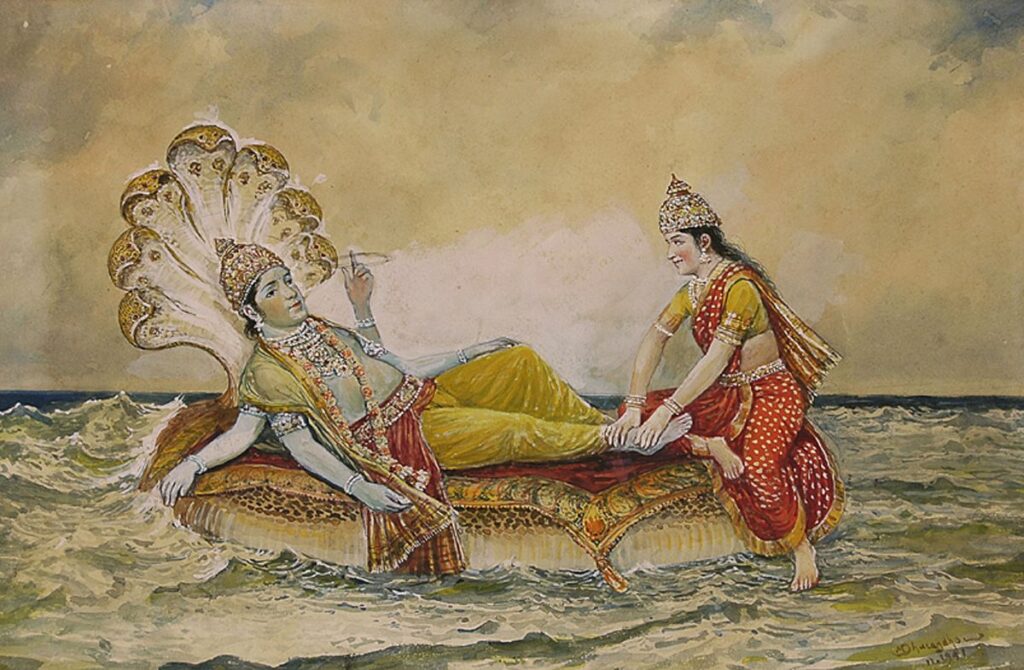
The boy was five years old, and all he wanted was to sit on his father’s lap. King Uttanapada was right there on the throne, and little Dhruva ran towards him with his arms raised. But his stepmother, Queen Suruchi, stood between them. She said coldly that he could not sit there, because he had not been born from her womb. If he wanted that seat, she said, he should go and worship Lord Narayana first.
The king said nothing. Dhruva ran out of the hall, hot with tears and anger, to the only person who would hold him. Years of silence had taught that boy one thing: the world had no place for him. A sage was about to teach him twelve syllables that would change that.
Om Namo Bhagavate Vasudevaya is the twelve-syllable (dwadashakshari) mantra of Lord Vishnu and Krishna. It means “I bow to Lord Vasudeva, the Supreme Lord.” Bhagavata Purana 4.8.54 gives it as the mantra the sage Narada taught the child Dhruva, and devotees chant it on Ekadashi, including Vaikuntha Ekadashi.
The mantra in Sanskrit, Hindi and Roman letters
ॐ नमो भगवते वासुदेवाय
oṁ namo bhagavate vāsudevāya
In simple English: I bow to the Lord, to Vasudeva. In Hindi: मैं भगवान वासुदेव को नमन करता हूँ।
| Mantra | Om Namo Bhagavate Vasudevaya (the Dwadashakshari, “twelve-syllable” mantra) |
|---|---|
| Deity | Lord Vishnu, in the form of Vasudeva (Krishna) |
| Source | Bhagavata Purana, Canto 4, Chapter 8, verse 54 |
| Who gave it | The sage Narada, to the child Dhruva |
| Syllables | oṁ-na-mo-bha-ga-va-te-vā-su-de-vā-ya (12) |
| Traditional occasions | Ekadashi, mornings, Vaikuntha Ekadashi |
| Vaikuntha Ekadashi 2026 | Sunday, 20 December 2026 (Drik Panchang, New Delhi) |
Suniti’s quiet advice: “Go to the one who holds the whole world”
Dhruva’s mother, Queen Suniti, lifted him onto her own lap. He was breathing hard, the Purana says, like a struck snake. She did not tell him that Suruchi was wrong to be unkind. She told him not to wish harm on anyone, and she admitted that the hurt had a real cause: the king’s love was simply elsewhere.
Then she gave him a different door to knock on. If he wanted a place no one could take away, she said, he should seek the Lord whom even Brahma and his own grandfather Manu had worshipped. Only that Lord could ease his sorrow. A grieving mother had little else to offer, yet it became the best advice in the whole story.
Narada on the road: the sage who tests a child’s resolve
Dhruva left the palace alone, walking towards the forest. The wandering sage Narada sensed what was happening and met him on the way. He first tried to talk the boy out of it. You are only a child, he said. Insults of this kind pass. Go home, grow up, and let life settle what it will.
Dhruva would not turn back. He said he was a kshatriya, and he wanted a place higher than any in the three worlds. Narada was pleased. He had tested the boy, and the boy had held. He blessed Suniti’s advice and sent Dhruva to Madhuvana, a forest on the banks of the Yamuna, to bathe, sit in meditation and worship.

The twelve syllables Narada gave him
Before Dhruva left, Narada described how to picture the Lord, and then gave him the mantra: ॐ नमो भगवते वासुदेवाय. With it, the Purana says, a wise worshipper should offer worship with whatever offerings suit the place and time. Narada also told him to practise it three times a day, as he bathed in the Yamuna.
The sage’s gift was the practice, not a promise. He gave a frightened five-year-old something to do with his hands, his breath and his mind. Notice, too, that Narada allowed a kshatriya child to chant even the Om. The Purana’s commentators read this as a sign that the mantra is meant for any devotee who comes with sincerity.
Om Namo Bhagavate Vasudevaya meaning, word by word
| Word | Meaning |
|---|---|
| Om (ॐ) | The sacred syllable that opens a mantra; the sound of the whole of existence |
| Namo (नमो, from namah) | I bow; salutation, surrender of the ego |
| Bhagavate (भगवते) | To the Lord; one who holds bhaga, divine glories such as wealth, strength, fame, wisdom and detachment |
| Vasudevaya (वासुदेवाय) | To Vasudeva: Krishna, son of Vasudeva, and also “the one who dwells in all beings and in whom all beings dwell” |
Put together, the mantra is a greeting and a surrender in one breath. The word namah blends into namo before bhagavate, which is why the written form reads “namo”. The ending -aya marks the one to whom the bow is offered. It is a mantra of address, not of asking, and that quiet detail explains a lot about how Dhruva used it.
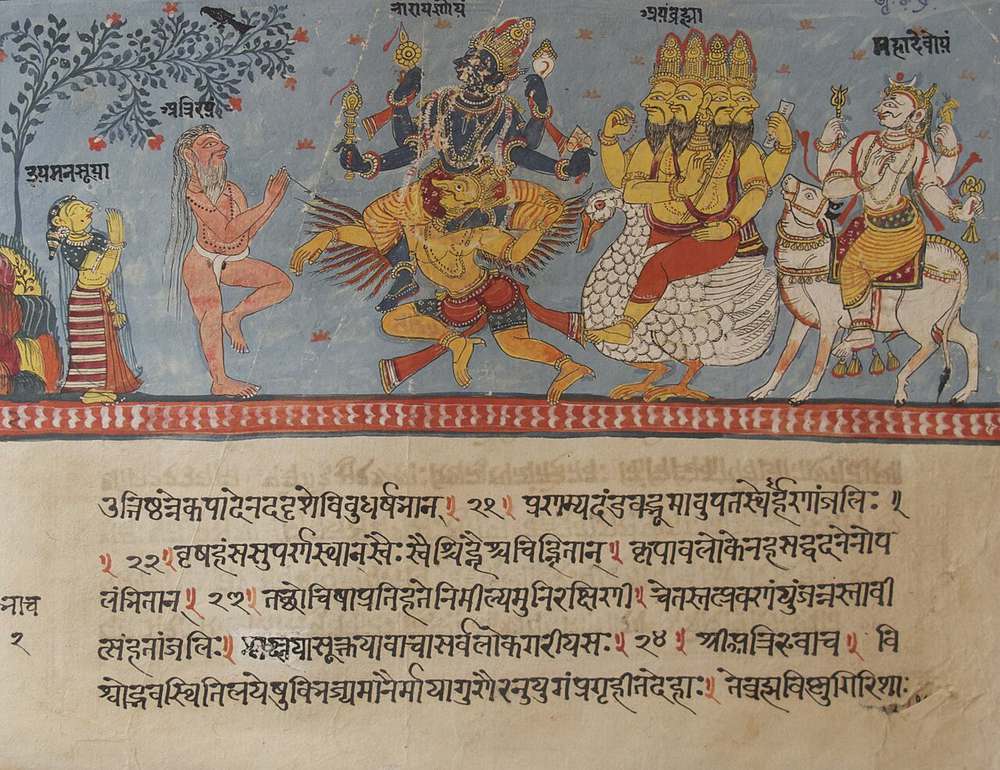

Madhuvana on the Yamuna: five months of tapasya
At Madhuvana, Dhruva began, and the Purana counts it month by month. In the first month he ate only fruit and berries, once in three days. In the second, dry grass and leaves, once in six days. In the third, only water, once in nine. In the fourth he lived on air, taking it once in twelve days.
In the fifth month he stood on one leg, still as a pillar, with his mind fixed on the Lord. The Purana says the three worlds began to tremble under the force of that devotion. The gods ran to Vishnu for help, and Vishnu replied that he would go to end the boy’s austerities.
The star that stays: where the story ends
Vishnu appeared before Dhruva. The boy, who had run from a palace asking for a lap, now found himself speechless. In the telling that follows in the next chapter, Vishnu touched the child’s cheek with his conch and gave him the words he lacked. Dhruva returned to rule, and when his time ended he was given an unmoving place in the sky: the pole star, Dhruva Tara, which stays fixed while every other star circles it.
That is why the story pairs so naturally with a mantra. Dhruva came wanting a seat on a lap. He chanted twelve syllables and received something no queen could take back.
How devotees chant it
Tradition suggests chanting after a bath, in the morning, facing east, in a quiet corner with a lamp and an image of Vishnu or Krishna. Many devotees chant it 108 times on a tulsi or sandalwood mala, one bead per chant, and some do a round or more on every Ekadashi. There is no fixed rule about numbers; some families chant it softly during daily work.
People chant it for peace of mind, steadiness in hard times and devotion. These are what devotees say they find; nobody can promise results, and the practice is best learned from your family tradition or a teacher you trust. The Purana itself notes that the mantra is traditionally received from a guru.
Vaikuntha Ekadashi 2026: the day the northern gate opens
In Vishnu temples across the south, one gate stays shut all year: the Vaikuntha Dwaram, the northern door of the sanctum. On Vaikuntha Ekadashi, also called Mukkoti Ekadashi, it opens. Devotees queue through the night to walk through it, believing it is like stepping towards Vishnu’s own abode, Vaikuntha. Temples such as Ranganathaswamy at Srirangam and the Tirumala temple are especially known for it.

The date: Drik Panchang lists Vaikuntha Ekadashi 2026 on Sunday, 20 December 2026. For New Delhi, the Ekadashi tithi begins at 10:09 PM on 19 December and ends at 8:14 PM on 20 December, and the fast is broken (parana) on Monday, 21 December, between about 7:10 AM and 9:13 AM. Because the tithi begins late on 19 December, some families and calendars mark the 19th instead, so check your own temple or local panchang.
On this day, devotees fast, stay awake with bhajans and chant Vishnu’s names, and the twelve-syllable mantra is a natural companion. For other Ekadashi stories, read the Mokshada Ekadashi vrat katha.
More Vishnu and Krishna mantras
- Shantakaram Bhujagashayanam, the peaceful dhyana shloka of Vishnu.
- The meaning and importance of Lord Vishnu’s mantra.
- The Krishna mantra of success.
ॐ नमो भगवते वासुदेवाय की कथा (संक्षेप में)
पाँच साल के बालक ध्रुव को सौतेली माँ सुरुचि ने पिता उत्तानपाद की गोद में बैठने से रोक दिया। रोते हुए ध्रुव अपनी माँ सुनीति के पास गए। सुनीति ने उन्हें भगवान की शरण में जाने की सलाह दी। रास्ते में देवर्षि नारद मिले, उन्होंने ध्रुव का संकल्प परखा और यमुना किनारे मधुवन भेजा। नारद ने उन्हें द्वादशाक्षर मंत्र दिया: ॐ नमो भगवते वासुदेवाय (श्रीमद्भागवत 4.8.54)। इसका अर्थ है, “मैं भगवान वासुदेव को नमन करता हूँ।” ध्रुव की तपस्या से प्रसन्न होकर विष्णु प्रकट हुए और ध्रुव को अटल स्थान मिला। वैकुंठ एकादशी 2026 में 20 दिसंबर को है (ड्रिक पंचांग, नई दिल्ली); अपने स्थानीय पंचांग से तिथि जाँच लें।
Sources and versions
The mantra and Dhruva’s story are from the Bhagavata Purana, Canto 4, Chapters 8 and 9 (the mantra at verse 4.8.54; the month-by-month austerities at 4.8.72-76). The Sanskrit text agrees across the editions we checked. The retelling above is in our own words; the Vishnu Purana and other texts also tell Dhruva’s story with small differences in detail. Date and timings for Vaikuntha Ekadashi: Drik Panchang, New Delhi.
Frequently asked questions
What is the meaning of Om Namo Bhagavate Vasudevaya?
It means “I bow to Lord Vasudeva, the Supreme Lord.” Vasudeva refers to Krishna, and also to the one who dwells in all beings.
Why is it called the Dwadashakshari mantra?
Dwadash means twelve and akshar means syllable. The mantra has twelve syllables: oṁ-na-mo-bha-ga-va-te-vā-su-de-vā-ya.
How many times should the mantra be chanted?
Traditionally 108 times on a mala, but there is no strict rule. Many devotees chant it daily, and more often on Ekadashi.
When is Vaikuntha Ekadashi in 2026?
Drik Panchang lists it on Sunday, 20 December 2026, with parana on 21 December. Some calendars mark 19 December because the tithi begins late that night, so check your local panchang.
This post is part of our mantras and shlokas collection. Next on the calendar: the Gita Jayanti and Mokshada Ekadashi, a few weeks before Vaikuntha Ekadashi.