
The last chapter of the Durga Saptashati is read. The demons Shumbha and Nishumbha are dead, the gods are free, and the lamp in front of the Goddess burns low. The family sitting around it has been reading for hours, and every one of them is tired. Then the final verses come, where the Goddess herself speaks and makes a promise to anyone who has listened with devotion. Many families repeat one line from it again and again, long after the reading ends.
Sarva Badha Vinirmukto mantra meaning: “By my grace, a person will be freed from all obstacles and blessed with wealth, grain and children; there is no doubt.” It is a verse from chapter 12 of the Devi Mahatmya (Durga Saptashati), spoken by Goddess Durga herself.
The Sarva Badha Vinirmukto mantra is Goddess Durga’s own promise from the Durga Saptashati: “By my grace, a person will be freed from all obstacles and blessed with wealth, grain and children; there is no doubt about it.” Devotees chant it to remove obstacles, fear and negativity and to bring success and prosperity. Below are the mantra in Sanskrit and English, its meaning in English and Hindi, its source, benefits and how many times to chant it.
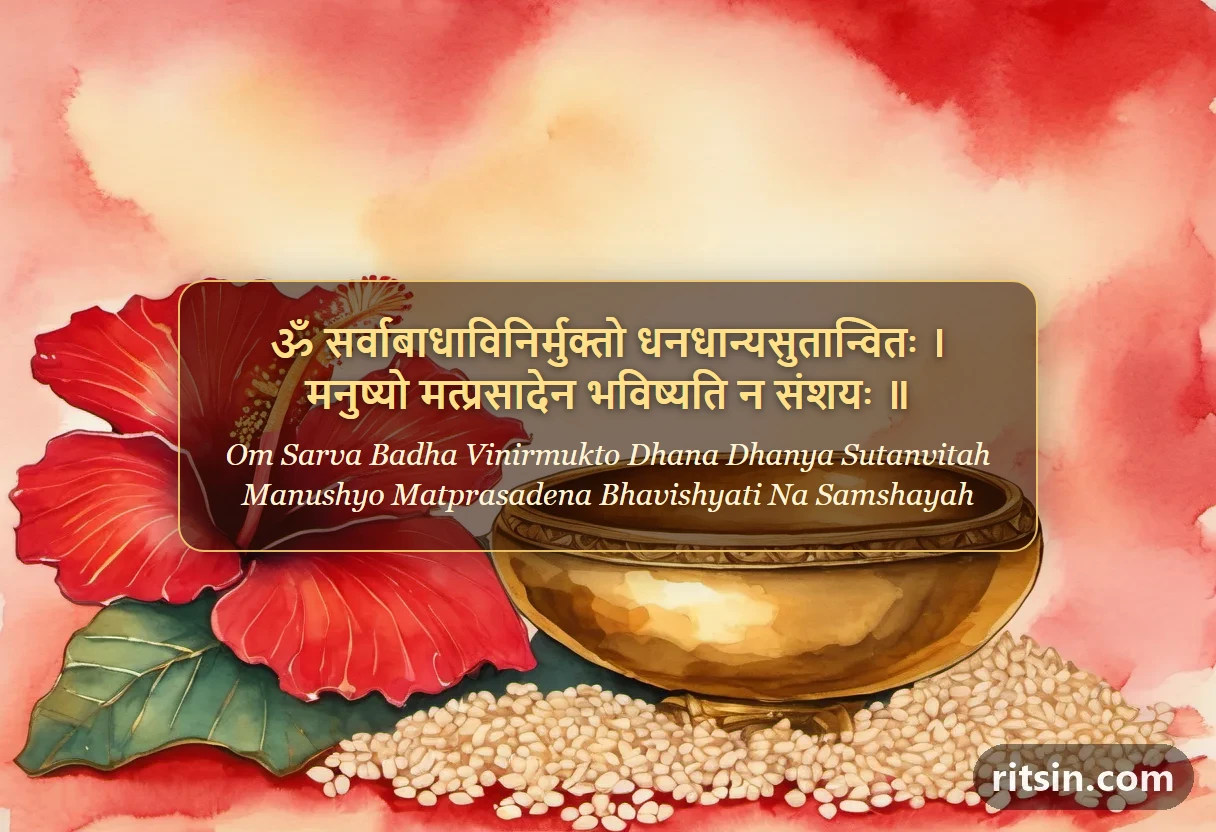
ॐ सर्वबाधा विनिर्मुक्तो धन-धान्य सुतान्वितः।
Om Sarva Badha Vinirmukto Dhana Dhanya Sutanvitah,
मनुष्यो मत्प्रसादेन, भविष्यति न संशयः॥
Manushyo Matprasadena Bhavishyati Na Samshayah
Sarva Badha Vinirmukto mantra meaning, word by word
| Word | Meaning |
|---|---|
| Sarva Badha | All obstacles and troubles |
| Vinirmuktah | Completely freed from |
| Dhana Dhanya | Wealth and grain (food, abundance) |
| Sutanvitah | Blessed with children |
| Manushyah | A human being |
| Matprasadena | By my grace (the Goddess speaking) |
| Bhavishyati | Will become |
| Na Samshayah | There is no doubt |
सर्वबाधा विनिर्मुक्तो मंत्र का अर्थ (meaning in Hindi)
देवी कहती हैं: “मेरी कृपा से मनुष्य सब बाधाओं से मुक्त होकर धन, धान्य और संतान से सम्पन्न होगा, इसमें कोई संदेह नहीं है।”
सर्व बाधा विनिर्मुक्तो मंत्र का अर्थ हिंदी में: इस श्लोक में देवी स्वयं वचन देती हैं कि उनकी कृपा से मनुष्य सभी बाधाओं से मुक्त होगा और धन-धान्य तथा संतान से युक्त होगा। यह श्लोक दुर्गा सप्तशती (देवी माहात्म्य) के बारहवें अध्याय का है।
शब्दार्थ: सर्वबाधा विनिर्मुक्तः = सभी बाधाओं से पूरी तरह मुक्त; धन-धान्य-सुतान्वितः = धन, अन्न और संतान से युक्त; मनुष्यः = मनुष्य; मत्प्रसादेन = मेरी कृपा से; भविष्यति = होगा; न संशयः = इसमें कोई संदेह नहीं।
इस मंत्र को पढ़ने वाले कई भक्त इसे श्रद्धा से, शांत मन से और दुर्गा सप्तशती के पाठ के बाद दोहराते हैं। इसके फल को लेकर परंपरागत मान्यता है, कोई गारंटी नहीं।
Where the mantra comes from
The verse is from the twelfth chapter of the Devi Mahatmya (Durga Saptashati), where the Goddess herself describes the blessings received by those who read and listen to her glories. That is why it is chanted as a promise of her grace, and often recited at the end of the Durga Saptashati path.
Devotees who like this verse often also chant Sarva Mangala Mangalye, another Durga mantra of blessing, or turn to the eight powerful mantras of Maa Durga during Navratri.


Benefits of chanting Sarva Badha Vinirmukto
This mantra is considered very powerful, and devotees who face challenges and obstacles often recite it. The blessings traditionally associated with it are:
- Removal of obstacles and difficulties in life, work and business.
- Success and prosperity: wealth, food and a happy family.
- Protection from negative energy, enemies and harmful influences.
- Freedom from fear and doubt, and a steadier mind.
It is important to remember that chanting brings blessings and positive energy, but it is ultimately up to each of us to act and make the effort needed to overcome obstacles and succeed.
How to chant it, and how many times
- When: any time during daily puja; regular practice is more effective than occasional chanting. Navratri, Fridays and Ashtami are especially auspicious.
- How many times: 11 or 21 times daily, or 108 times (one mala) for a full practice; some devotees keep a 40-day vow.
- How: sit before an image of Maa Durga, light a lamp, and chant with devotion and attention to the meaning.
Frequently asked questions
Which text is the Sarva Badha Vinirmukto mantra from?
From chapter 12 of the Devi Mahatmya (Durga Saptashati), part of the Markandeya Purana.
Who can chant this mantra?
Anyone can chant it with devotion; it is one of the most popular Durga mantras recited at home.
What is the Sarva Badha Vinirmukto mantra meaning in Hindi?
सर्वबाधा विनिर्मुक्तो मंत्र का अर्थ है: देवी की कृपा से मनुष्य सब बाधाओं से मुक्त होकर धन, धान्य और संतान से सम्पन्न होगा, इसमें कोई संदेह नहीं। यह दुर्गा सप्तशती के बारहवें अध्याय का श्लोक है।
Is it “Sarva Badha” or “Sarvabadha” Vinirmukto?
Both spellings are the same mantra. In Sanskrit the words join as sarvabādhā-vinirmuktaḥ, and “Sarva Badha”, “Sarvabadha” and “Sarv Badha” are only different ways of writing it in English letters.
How many times should the Sarva Badha Vinirmukto mantra be chanted?
There is no fixed rule in the text. Devotees commonly chant it 11 or 21 times a day, or 108 times with a mala, and it is often read at the end of the Durga Saptashati path.
Sources and versions
The verse is in the closing chapter (the phalashruti) of the Devi Mahatmya, which sits in the Markandeya Purana; see the Devi Mahatmya overview. Verse numbering varies slightly between editions, and the chanting counts are devotional custom, not a rule of the text.
Read next
- Eight powerful mantras of Maa Durga
- Sarva Mangala Mangalye mantra
- Ya Devi Sarva Bhuteshu with meaning
- Om Gam Ganapataye Namaha, the Ganesha mantra for removing obstacles
- ॐ श्री चित्रगुप्त नमः
- The Story of Bharata – Younger brother of Lord Rama
- Ya Devi Sarva Bhuteshu: Full Lyrics and Meaning (Devi Suktam)
- Andal: The Girl Who Wore the Garland Before Vishnu Did
- Lord Nataraja
- Tulsi Vivah Story: Why Vrinda Cursed Vishnu
- Kartik Poornima (Kartik Purnima) festival
- Draupadi Cheerharan Explained: The Turning Point in Mahabharata’s Fate
- Draupadi’s Story: The Fire Princess & Her Destiny in the Mahabharata
- When Arjuna was killed (Mahabharat)
- Ramayana – The legend of prince Rama
- When Dhritarashtra was surprised
- Lohri Mata ki Katha
- The Wives of Lord Krishna: Exploring Love, Devotion, and Spiritual Significance
- Lord Ganesha
- Hindu Mythology’s Power Couple: Unveiling the Story of Arjuna and Chitrangada
- When Vishwamitra and Vasistha used Brahmastra weapon
- Lord Vishnu’s eleventh avatar