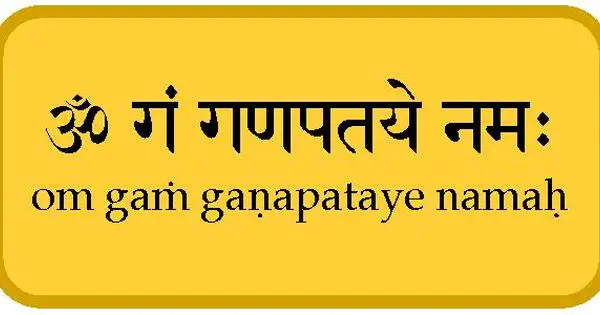
Om Gam Ganapataye Namaha (ॐ गं गणपतये नमः) means “Om, salutations to Lord Ganesha, the lord of the ganas.” It is Ganesha’s root (mula) mantra, built on his seed sound Gam, and Hindus chant it before any new beginning to remove obstacles. Below are the word-by-word meaning, the meaning in Hindi, where the mantra comes from, its benefits and how many times to chant it.
ॐ गं गणपतये नमः
Ganesh Maha Mantra
Om Gam Ganapataye Namaha
Om Gam Ganapataye Namaha meaning, word by word
| Word | Sanskrit | Meaning |
|---|---|---|
| Om | ॐ | The primordial sound; it represents the universe and the oneness of all creation, and opens most prayers. |
| Gam | गं | The bija (seed) mantra of Lord Ganesha; it is believed to hold the essence of his energy. |
| Ganapataye | गणपतये | “To Ganapati”, the lord of the ganas (Shiva’s attendants and all groups of beings). |
| Namaha | नमः | “I bow to you”, salutations; it signifies offering respect and devotion. |
Combined meaning: when chanted together, the mantra becomes a prayer that translates roughly to:
“Om, I awaken the essence of Lord Ganesha, the remover of obstacles, and offer my salutations to him.”
ॐ गं गणपतये नमः का अर्थ (meaning in Hindi)
ॐ गं गणपतये नमः का अर्थ है: “ॐ, गणों के स्वामी भगवान गणेश को मेरा नमन।” गं भगवान गणेश का बीज मंत्र है, गणपतये का अर्थ है गणों के स्वामी के लिए, और नमः का अर्थ है नमस्कार। किसी भी नए काम की शुरुआत से पहले विघ्नों को दूर करने के लिए यह मंत्र जपा जाता है।
Where the mantra comes from
Om Gam Ganapataye Namaha (Sanskrit: ॐ गं गणपतये नमः) is a powerful prayer composed of four parts in praise of Lord Ganesha. It is drawn from the Ganapati Atharvashirsha (also called the Ganapati Upanishad), the Sanskrit text in adoration of Ganesha that describes Gam as his seed syllable. That is why this short line is also known as the Ganesh Maha Mantra.

Benefits of chanting Om Gam Ganapataye Namaha
Devotees chant this mantra when inner or outer obstacles are holding them back from reaching their true self and their full potential. The benefits traditionally associated with it are:
- Removing obstacles before a new venture, a journey, an exam or a puja, since Ganesha is Vighnaharta, the remover of obstacles.
- Auspicious beginnings: it is recited first, before any other mantra or ritual.
- Focus and wisdom: Ganesha is the lord of intellect (buddhi), so students chant it before studying.
- A calm, positive mind: steady repetition settles the mind and builds faith and confidence.
How to chant it, and how many times
- When: in the morning after a bath, before starting work or study; Wednesdays, Sankashti Chaturthi and Ganesha Chaturthi are considered especially auspicious.
- Where: facing an image of Lord Ganesha, or east, in a clean and quiet place.
- How many times: 11 or 21 times daily for beginners; 108 times (one round of a mala) for a full practice. A rudraksha or sandalwood mala of 108 beads helps keep count.
- How: say it clearly and slowly. “Gam” is pronounced close to “gum”; the dot over ग (anusvara) gives it a nasal ending, which is why it is also written Om Gan Ganapataye Namah.
- Finish with a moment of silence and, if you like, an offering of durva grass, modak or a flower to Ganesha.
What Lord Ganesha teaches
Lord Ganesha is a symbol of positivity and faith. He reminds us that positive thinking is a mental practice: with time and effort we can shift our views from pessimism to optimism. He represents the unending potential in whole-hearted belief.
We are likely to succeed when we have faith in our heart’s desires and in our choices. Lord Ganesha teaches us to believe in ourselves. Each person holds the power to bring their aspirations into physical existence, and the Lord helps guide us on our way. There are also eight famous forms of Lord Ganesha, the Ashtavinayaka.
Frequently asked questions
Is Om Gam Ganapataye Namaha a beej mantra?
Gam (गं) is Ganesha’s beej (seed) mantra. The full line, Om Gam Ganapataye Namaha, is his mula (root) mantra built around that seed sound. Read more in Beej Mantras and their meaning.
Which is correct: Om Gam or Om Gan Ganapataye Namah?
Both refer to the same mantra. It is written ॐ गं गणपतये नमः; the anusvara on गं is pronounced as a nasal sound, so some people write it “Gan”.
How many times should I chant it?
108 times is the traditional count for one full round. If that is too long, 11 or 21 times every day with full attention is a good start.
Can anyone chant this mantra?
Yes. It is one of the most widely chanted Hindu mantras, recited at home by people of all ages; what matters most is devotion and clear pronunciation.
Read next
- 108 names of Lord Ganesha
- Seven interesting stories of Lord Ganesha
- Sarva Badha Vinirmukto mantra for removing obstacles
- Festival of Ganesha Chaturthi
- All Lord Ganesha stories
- Lord Ganesha – Marriage
- Ganesha Mantras: For Removing Obstacles and Achieving Success
- Lord Ganesha: Significance, Mantras & the Beloved Remover of Obstacles
- 108 names of Lord Ganesha
- Interesting story of birth of Lord Ganesha and duel with Shiva
- Clever Ganesha and Sage Gautam
- Clever Ganesha and Narada’s mango – Indian mythology
- Great stories about Lord Ganesha
- Moreshwar (Mayureshwar) – Lord Ganesha Temple
- Siddhivinayak – Lord Ganesha Temple
- Ballaleshwar Temple – Abode of Lord Ganesha
- Varada Vinayak – Ashtavinayak temple of Lord Ganesha
- Chintamani – Ashtavinayak – Lord Ganesha
- Lord Ganesha stories
- Om Gam Ganapataye Namaha (ॐ गं गणपतये नमः): Meaning, Benefits and How to Chant