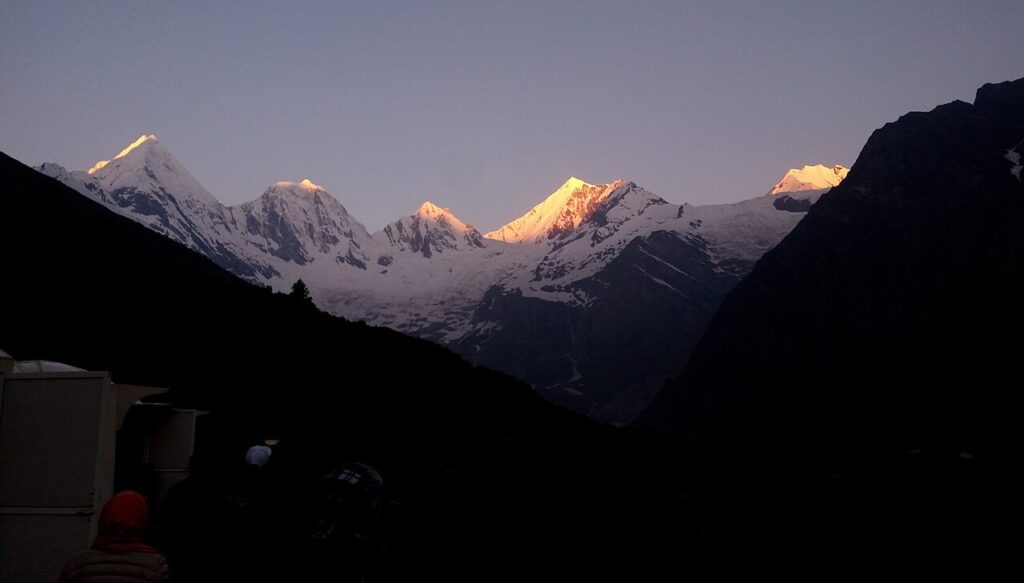
It is still dark when you wrap the blanket round your shoulders and step onto the balcony. The air bites. Below you the lights of Munsiyari are going out one by one, and across the valley there is only a long, black wall of sky with nothing in it.
Then the first peak catches fire. A thin line of gold touches its tip, and the next peak lights up beside it, and the next. Five white summits, side by side, each burning a little after the one before, like five hearths being lit in a row. Locals will tell you that is exactly what they are.
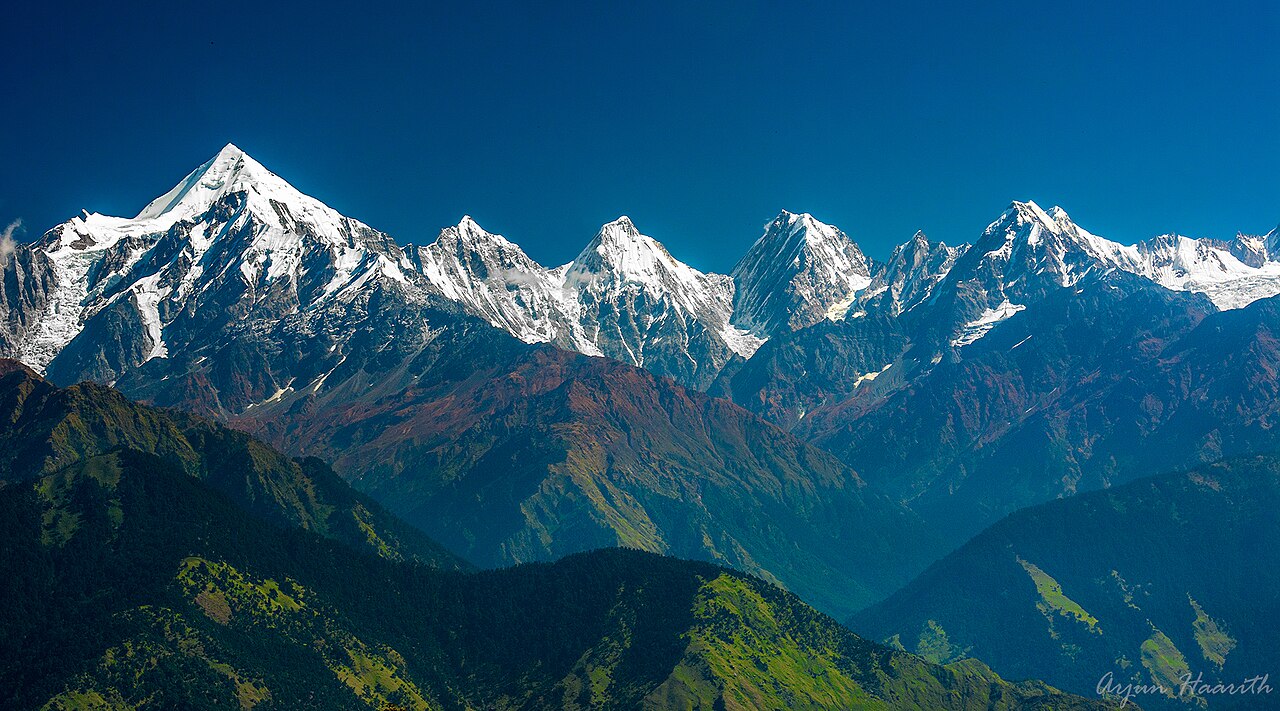
Munsiyari is a hill town at about 2,200 m in Pithoragarh district, Uttarakhand, facing the five Panchachuli peaks. Snowfall comes mainly between December and February (never guaranteed), the nearest railway station is Kathgodam and the nearest airport is Pantnagar, with roughly 220 to 285 km of road from Kathgodam depending on the source. Local tradition says the Pandavas cooked their last meal on those five peaks before they left for heaven.
Munsiyari in winter at a glance
| Where | Munsiyari, Pithoragarh district, Kumaon, Uttarakhand |
| Height | About 2,200 m (7,200 ft) |
| Snow season | Mainly December to February; sources differ, and snow is never guaranteed |
| Nearest railway station | Kathgodam, roughly 220 to 285 km by road (sources differ), a full day |
| Nearest airport | Pantnagar, about 250 km |
| Stay | Local homestays and state rest houses |
| Best for | Himalayan views, quiet winter walks, a short snow trek, travellers who like story-rich places |
The five hearths of the Pandavas
The Panchachuli range gets its name from the number five and the word for a stove. In the tradition told around Munsiyari, the five Pandava brothers came this way near the end of their lives, on the long walk north that would end in heaven. Before the final climb, Draupadi lit five hearths, one for each brother, and cooked their last meal together.
In that telling, when the meal was done and the brothers moved on, the five hearths turned to stone and ice. They are the five summits you see today. (Another explanation says chuli simply means peak in the Nepali language, so Panchachuli would be “five peaks”. Both ideas live side by side in the hills.)
This is a local legend, not a verse of the Mahabharata, so treat it as folk memory. The epic itself ends the Pandavas’ journey in the high Himalaya, as you can read in our story of the Pandavas in exile and in why Draupadi and the Pandavas were born.

The traders who came down for the winter
Long before tourists came for the snow, Munsiyari had its own winter visitors. In the high Johar valley, villages such as Milam and Laspa were buried by snow every year and cut off from the world. The Bhotia traders who lived there, men who walked the old trade routes to Tibet, packed up and came down to Munsiyari, where the climate is comparatively milder.
They waited out the cold here, then climbed back when the passes opened. So winter in Munsiyari has always been a season of arrivals. When you wake to snow on the roofs, you are in a town that was built to shelter people from exactly this weather.
When does Munsiyari get snowfall?
The winter season runs from late November to early March. Snowfall is mainly in December and January, and some guides say January and February are the surest months. Sources differ, so plan for the whole window and not for one date.
Snow can be light in one year and heavy in the next, and it does not fall on a schedule. Nights are very cold. Even without snow, the Panchachuli view on a clear winter morning is worth the journey, because the winter air is sharp and clean.
In mid-January, when the hill villages light bonfires for Lohri and Makar Sankranti, the cold is at its deepest. Read about it in our Lohri story and you will see why fire matters so much in these hills.
A walk to the goddess
The most rewarding short walk in town goes to the Nanda Devi temple, about 3 km from Munsiyari (sources say 2.9 to 4 km), reached on foot. Nanda Devi is the mountain goddess of Kumaon and Garhwal, and her shrines sit high on ridges where she can look at her own peaks. In snow, the path through the trees turns white and quiet.
On the road into town you also pass Kalamuni Temple, which has a viewpoint of its own. Take a flask of tea and a pair of boots with a good grip. Ask locally about the path before you set out, since snow changes it quickly.

The snow trek to Khaliya Top
If you want to walk in real snow, the trek to Khaliya Top, at about 3,500 m, is the classic choice. One travel guide (TravelTriangle) puts it at six to seven hours from Balati Farm, which is itself about 4 km from town. Treat that as a guide’s estimate, because snow and fitness change the time.
Go with a local guide in winter. The same guide mentions Birthi Falls, a fall of about 126 m a short drive away, and Thamri Kund, a secluded lake that can be partly frozen in the cold months, a trek away. Ask your host which of these are open on the day you arrive.
How to reach Munsiyari
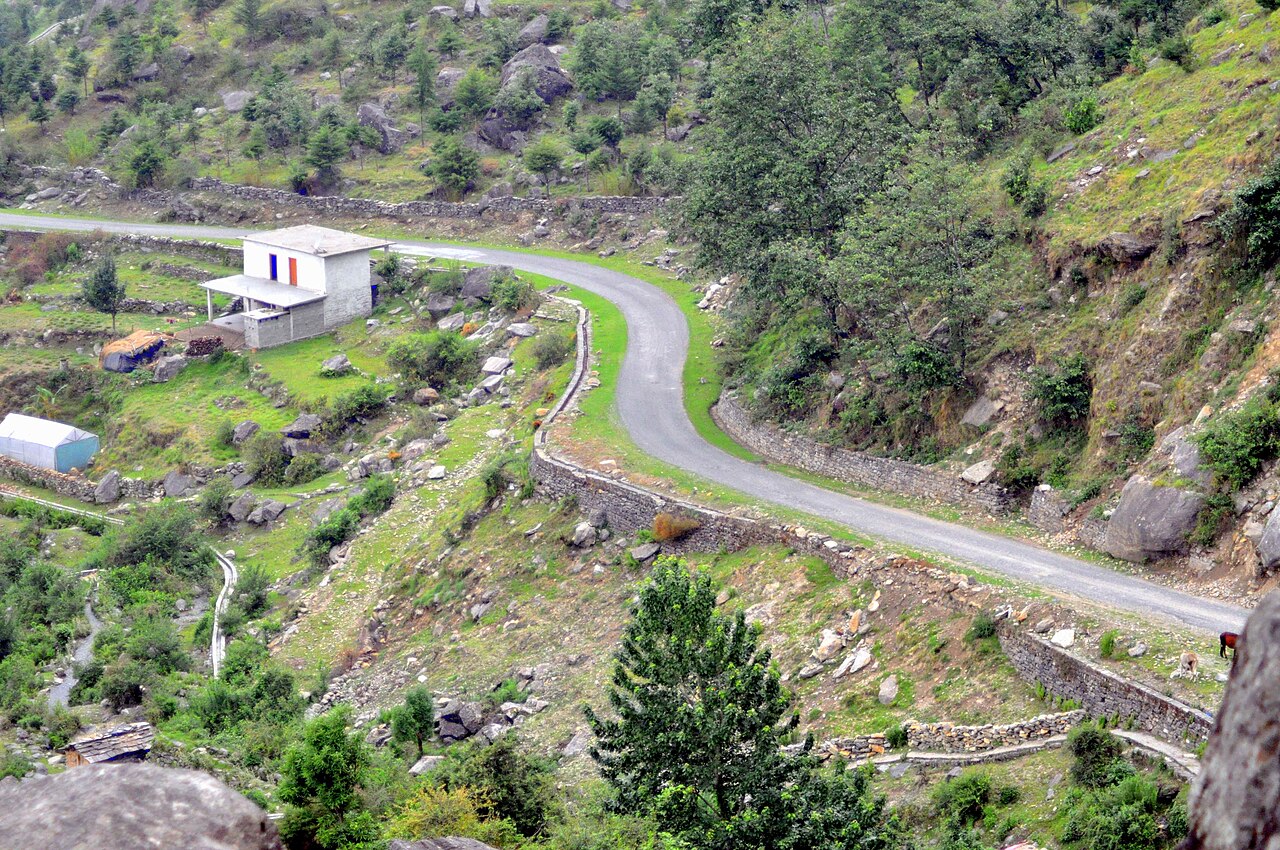
Take a train to Kathgodam, then spend a full day on the road through Almora and Bageshwar. The distance is quoted anywhere from about 217 to 286 km, so say “roughly 220 to 285 km”. Pantnagar is the nearest airport, about 250 km away. State and private buses run from Delhi, Dehradun, Haldwani and Kathgodam.
After snow, the stretch near Kalamuni can slow down or close, so build in a buffer day at both ends and ask your driver about road status before you leave. Check current conditions locally; no article can promise them.

Where to sleep and what to carry
Munsiyari has local homestays and state rest houses. A local homestay brings a host who knows the weather. Confirm heating, hot water, meals and what is included when you enquire, and book ahead for the December holidays.
- Warm layers, a woollen cap, gloves and thermals.
- Shoes with a good grip for icy paths.
- A torch, a power bank and some cash.
- Two spare days in your plan for road delays.
Best time to visit Munsiyari
Come between December and February if you want snow, knowing it is never certain. March to June and September to November give clearer Panchachuli views and easier trekking. If you want both a legend and a quiet town, winter is the season that rewards patience.
Pilgrims will also like to know that the same Himalaya hides the Pandavas’ last journey elsewhere too; see the Kedarnath temple story.
Questions travellers ask
Does Munsiyari get snow in December?
It can. Snowfall is mainly in December and January, with some sources adding February. It varies each year, so do not plan around a guarantee.
How many days do I need for Munsiyari?
Plan three nights in town, plus a day each way for the road. That gives you time for the Nanda Devi temple walk, a sunrise on the Panchachuli peaks and a short trek.
How do I reach Munsiyari from Delhi?
Take an overnight train to Kathgodam, then a taxi or bus through Almora and Bageshwar. Buses also run from Delhi, Dehradun and Haldwani. Allow a full day for the hill road.
Why is it called Panchachuli?
Tradition says the five peaks are the five hearths where the Pandavas cooked their last meal. Another view says chuli means peak in Nepali, so the name means “five peaks”.
Sources and versions
Town facts and the Bhotia winter move: Wikipedia, Munsiyari. Snow window, Khaliya Top, Nanda Devi temple and road distances: TravelTriangle and StayVista guides and Holidify (figures differ between them). The Panchachuli hearth legend is a local tradition retold by travel writers (Tripoto), not a Mahabharata verse.
More journeys like this are in our Travel section; the next Himalayan winter story is never far away.