
Smoke rose from a funeral pyre, and Vishnu would not leave it. Vrinda, the wife of the asura Jalandhara, had just given up her life in grief and rage. A moment earlier she had cursed the god she worshipped every day: you who have a heart of stone, become a stone. Now the preserver of the world sat beside her ashes, silent, while the gods waited and the universe lost its balance.
What Vishnu did next explains something you may have seen all your life: why a Tulsi plant in a courtyard is married to a black stone every November, with a mandap, sugarcane and a band playing. That is the Tulsi Vivah story.
Tulsi Vivah in short, and the date
Tulsi is wed to Vishnu in his Shaligram form because Vrinda cursed Vishnu to become a stone after he took her husband’s form and broke her vow. Vishnu accepted the curse and promised that she would be reborn as the Tulsi plant and be married to him as Shaligram. That is why Tulsi Vivah is held after Dev Uthani Ekadashi, on 21 November 2026.
| Dev Uthani Ekadashi 2026 | Friday, 20 November 2026 (some Vaishnava traditions observe it on 21 November) |
|---|---|
| Tulsi Vivah 2026 | Saturday, 21 November 2026 (Kartik Shukla Dwadashi); in some regions it is held on Ekadashi night or any day up to Kartik Purnima |
| Evening muhurat | About 5:24 PM to 8:46 PM in New Delhi (pradosh kaal), per published panchangs. Check your city’s panchang. |
| The couple | Tulsi (Vrinda) and Vishnu as the Shaligram stone, or an image of Krishna |
| Main texts | Padma Purana, Shiva Purana (Jalandhara version); Devi Bhagavata Purana (Shankhachuda version) |
Who was Vrinda, and why was her husband unbeatable?
Vrinda was a devotee of Vishnu from childhood. In the Puranic tellings she is the daughter of the asura Kalanemi, and she married Jalandhara, a mighty asura born from the fire of Shiva’s anger and raised by the ocean. Her devotion and her faithfulness to her husband created a protective power around him. As long as Vrinda kept her vow, no god could kill Jalandhara.
That power made Jalandhara reckless. He challenged the gods, and then he turned his eyes on Parvati and went to war with Shiva himself. Shiva’s weapons found no way through. You can read the full war in our post on Jalandhara and Vrinda. Here we stay with what happened at the end of it.
How Vishnu broke Vrinda’s vow
The gods went to Vishnu: Jalandhara could not die while Vrinda’s vow held. In the Puranic tellings, Vishnu then took Jalandhara’s form and came to Vrinda. She greeted her husband, believing he had returned safe from battle, and her vow broke. At that moment Shiva killed the real Jalandhara.
When Vrinda learned the truth, she was shattered. She cursed Vishnu to become a stone, since he had shown no feeling for her. Some versions add that he would be separated from his own wife, which devotees connect with Rama losing Sita in the Ramayana. Then Vrinda gave up her life on the pyre.
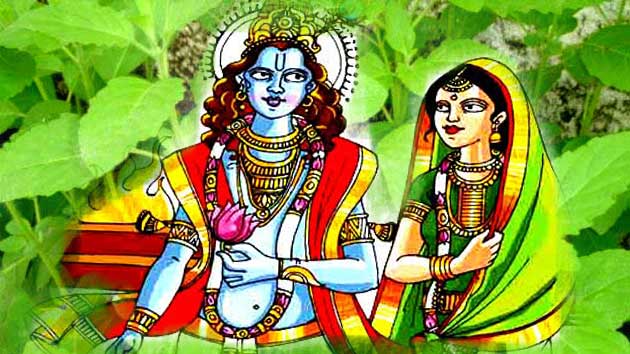
Vrinda’s curse: why Vishnu became the Shaligram stone
Vishnu accepted the curse. He did not argue, and he did not leave her pyre. Grieving, he refused to move until the gods begged him and the goddess Prakriti intervened. From the ashes of Vrinda, the tradition says, the Tulsi plant grew. (Wikipedia notes another telling in which three plants, Dhatri/amla, Malati and Tulasi, sprang from three seeds.)
Vishnu made her a promise. In her next birth she would be his wife, and he, in the form of the stone she had cursed him into, would marry her. The black stone is the Shaligram, found in the Gandaki river of Nepal and worshipped as a form of Vishnu. Devotees also say that no Vishnu puja is complete without Tulsi leaves.
The other telling: Tulsi and Shankhachuda
The Devi Bhagavata Purana tells a different story, and the two should not be mixed. Here, Tulsi is the daughter of King Dharmadhvaja and is seen as a form of Lakshmi. She does penance at Badrinath to win Vishnu as her husband, but Brahma tells her she must first marry the daitya Shankhachuda, who is protected by a boon as long as he wears Vishnu’s armour.
When Shankhachuda’s pride troubles the gods, Shiva kills him with Vishnu’s trident, while Vishnu takes Shankhachuda’s form and approaches Tulsi. She finds out and tries to curse him. Vishnu shows his true form and tells her to leave her body and join him in Vaikuntha. Her body becomes the Gandaki river, and her hair becomes the Tulsi plant. In a regional variant, Tulsi curses Vishnu to become stone, and he becomes the shaligram stones of the Gandaki.
Both tellings agree on three things: Vishnu deceives a faithful woman, she becomes Tulsi, and Vishnu becomes Shaligram. For the wider family of texts, see our guide to the 18 Puranas.
Tulsi Vivah rituals: the mandap, sugarcane and the wedding season
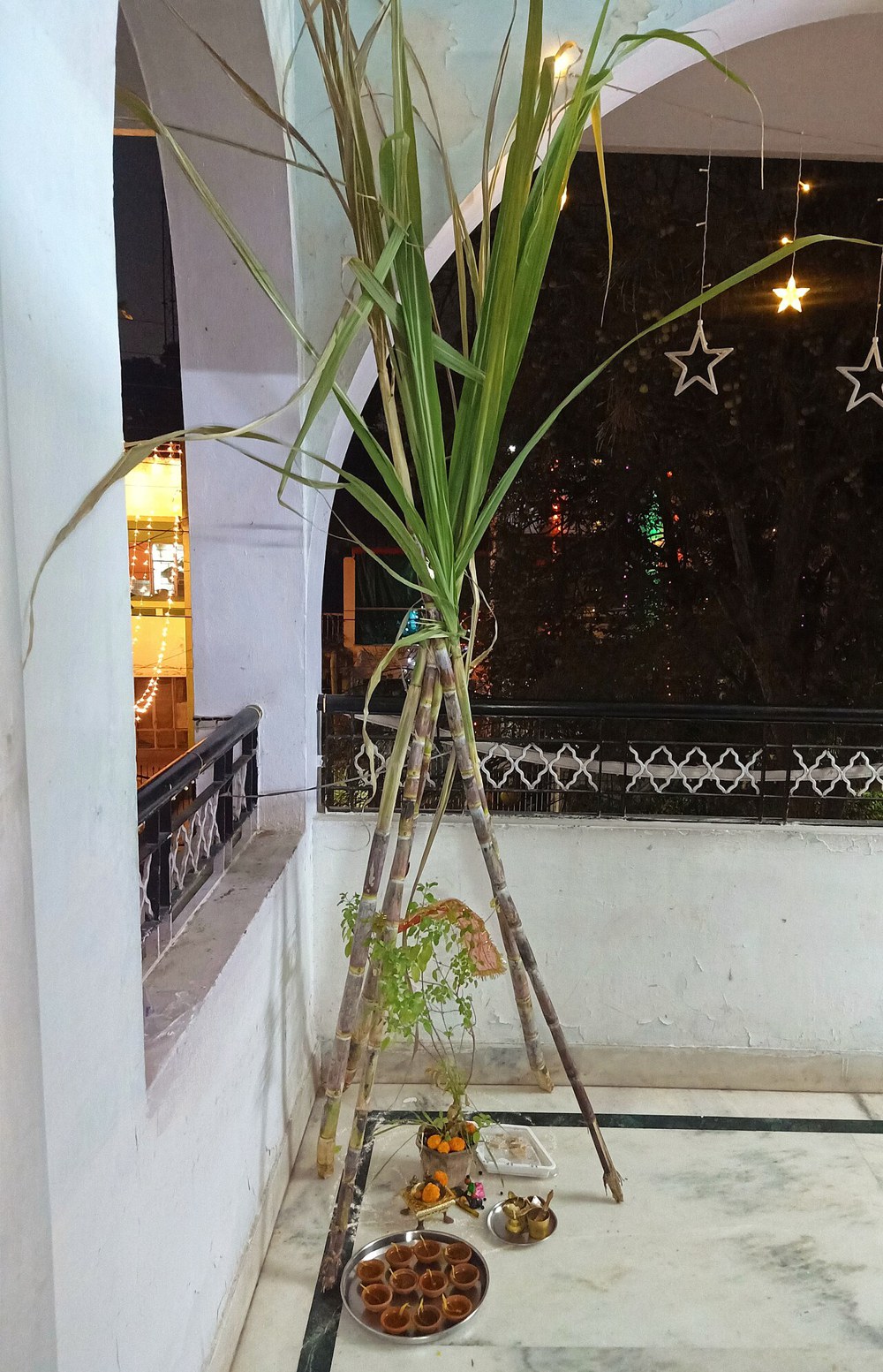
Tulsi Vivah is a full wedding. The Tulsi plant stands in her vrindavan (the brick or clay planter, named after Vrinda), and a mandap is built around it, often from sugarcane stalks. The plant is dressed in a sari and ornaments. The groom is the Shaligram stone, or a brass image or picture of Vishnu or Krishna.


- Fast until evening, as many families do on the wedding day.
- Bathe and dress the couple: Tulsi in a sari, Shaligram bathed and decorated.
- Tie them with a cotton thread and hold a cloth between them while the mantras are recited, a custom seen in Maharashtra.
- Shower rice mixed with vermilion, light diyas and offer sugarcane, coconut, fruit and sweets.
- Share the prasad with family and neighbours.
Amla in the south, and the start of the wedding season
In Andhra Pradesh and Telangana, an amla branch stands for Vishnu in the Tulsi planter, and the ceremony is held on Dwadashi. Tulsi Vivah also marks the end of the monsoon and the start of the Hindu wedding season: after Vishnu wakes on Dev Uthani Ekadashi, weddings can begin. Read about the day’s fast in our guide to the Ekadashi vrata.

What the story teaches
The story does not hide Vishnu’s act. It shows a god who accepts a devotee’s curse and repays her grief by making her sacred: she lives in every home as a plant people water and circle each day. Many families see Tulsi as a form of Lakshmi, and the sacred plants of India include her for that reason.
तुलसी विवाह की कथा (संक्षेप में)
वृंदा असुर जालंधर की पतिव्रता पत्नी और भगवान विष्णु की भक्त थीं। उनके सतीत्व के कारण जालंधर को कोई देवता नहीं मार पाता था। तब विष्णु ने जालंधर का रूप धरकर वृंदा का व्रत भंग किया और शिव ने जालंधर का वध किया। सच जानकर वृंदा ने विष्णु को पत्थर बनने का श्राप दिया और स्वयं सती हो गईं। विष्णु ने श्राप स्वीकार किया और वचन दिया कि वृंदा तुलसी के रूप में पूजी जाएँगी और वे शालिग्राम बनकर उनसे विवाह करेंगे। इसी कारण देवउठनी एकादशी के बाद कार्तिक शुक्ल द्वादशी को तुलसी-शालिग्राम विवाह होता है। इस वर्ष तुलसी विवाह शनिवार, 21 नवंबर 2026 को है; अपने शहर का पंचांग देख लें।
Frequently asked questions
Is Tulsi Vivah on Ekadashi or Dwadashi?
Most families hold it on Dwadashi, the day after Dev Uthani Ekadashi, which is 21 November 2026. Some temples and families do it on Ekadashi night, and the ceremony may be held on any day until Kartik Purnima. Follow your family’s custom and local panchang.
Why is Tulsi married to Shaligram?
Because Vrinda cursed Vishnu to become a stone, and Vishnu promised to marry her in her Tulsi form. The Shaligram is that stone, and the Tulsi plant is Vrinda.
Why does the wedding season start after Tulsi Vivah?
Vishnu sleeps during the four months of Chaturmas, when weddings are avoided. After he wakes on Dev Uthani Ekadashi and the Tulsi marriage is performed, the wedding season opens.
Is Vrinda the same as Tulsi?
Yes. In the Jalandhara story, Vrinda becomes the Tulsi plant, and Tulsi is also called Vrinda, which is why the Tulsi planter is called Vrindavan.
More on Vishnu’s fasting days is on our Ekadashi hub. Next on the calendar is Kartik Purnima. Dates are from published panchangs; verify on Drik Panchang. Legend summary: Wikipedia.