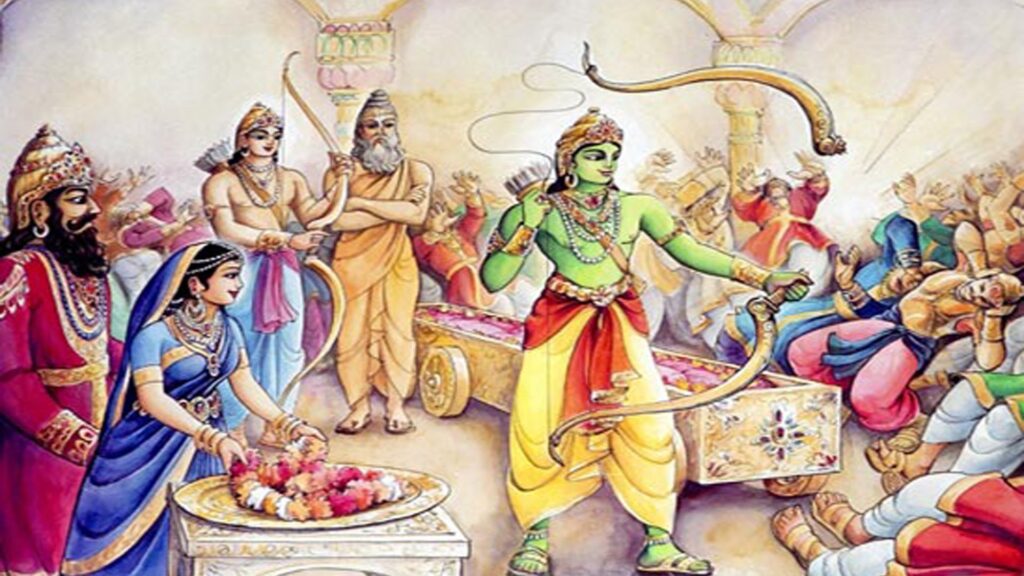
The great bow of Shiva lay on an eight-wheeled iron chest, and it took five thousand strong men to drag it into Janaka’s hall. For years, kings from across the land had come to Mithila, tried to lift it, and gone home with sore shoulders and wounded pride. Janaka had made a vow: whoever could string that bow would marry his daughter Sita, the girl he had found in a furrow of his own field.
Then a young prince from Ayodhya walked up, lifted the bow and bent it to string it. It snapped in two with a crack like thunder, and everyone in the hall fell to the floor in fright except Janaka, the sage Vishwamitra and the two brothers. That crack led to a wedding that Janakpur still celebrates every year on Vivah Panchami.
Vivah Panchami 2026, at a glance
Vivah Panchami is the wedding day of Rama and Sita, observed on the fifth day of the bright half (Shukla Panchami) of Margashirsha. In 2026 it falls on Monday, 14 December. Rama won Sita’s hand by breaking Shiva’s bow at her swayamvara, and the wedding took place at Janakpur in Mithila. Janakpur and Ayodhya celebrate it most grandly, though many Mithila families avoid fixing their own weddings on this day.
| Vivah Panchami 2026 | Monday, 14 December 2026 (Margashirsha Shukla Panchami) |
|---|---|
| Panchami tithi | Roughly from the evening of 13 December to the evening of 14 December (New Delhi); exact times differ by city, so check your local panchang |
| What it marks | The wedding of Rama and Sita, and of his three brothers |
| Main places | Janakpur (Nepal), Ayodhya, Mithila |
| Told in | Valmiki Ramayana (Bala Kanda), Tulsidas’s Ramcharitmanas |
How Rama won Sita: the bow that nobody could lift
Sita was no ordinary princess. Janaka, king of Videha, had been ploughing a field for a sacrifice when a baby girl came up with the plough’s tip (sita means furrow). He raised her as his own. When she grew up, he decided that only a man of extraordinary strength would be worthy of her, and he set the test of Shiva’s bow, an heirloom of his family. You can read the full scene in our post on Sita’s swayamvara.
The sage Vishwamitra had brought Rama and Lakshmana to Mithila after they protected his sacrifice from demons. He asked Janaka to show the princes the bow. Rama lifted it in front of the whole court, strung it, drew it, and it broke. Janaka, overcome with relief, announced that Sita would be Rama’s wife, and sent swift messengers to Ayodhya to bring King Dasharatha.

Four brothers, four brides: the wedding at Janakpur
The messengers rode for three nights to reach Ayodhya. Dasharatha, delighted, set out with his sages, ministers and army, and Janaka received the whole party at his city. Then came a surprise: Vishwamitra and the priests of both houses proposed that the wedding should not stop at one couple.
Janaka’s younger brother Kushadhvaja had come from his own city, Sankashya, and he had two daughters, Mandavi and Shrutakirti. Janaka’s second daughter, Urmila, was Sita’s sister. So in one ceremony, Rama married Sita, Lakshmana married Urmila, Bharata married Mandavi and Shatrughna married Shrutakirti. Four sons of one house wed four daughters of the other.
At the altar, Janaka poured water into Rama’s hand, the traditional sign of giving a daughter away, and offered Sita with words that are still quoted at weddings: this is my daughter Sita, who will walk beside you in dharma; take her hand. The couples circled the sacred fire, the altar, the king and the sages. The Ramayana says flowers fell from the sky, celestial drums sounded and the apsaras danced.


Valmiki and Tulsidas tell the wedding differently
In Valmiki’s Bala Kanda, the wedding is a stately royal affair, full of lineage recitals, royal courtesy and Vedic rites. The focus is on duty, family and kingship, and Valmiki records the fire and the four couples without dwelling on the bride’s and groom’s feelings.
Tulsidas, writing the Ramcharitmanas in Awadhi centuries later, adds the tenderness. In his telling, Sita and Rama first see each other in Janaka’s flower garden, where she has gone to pray to Goddess Gauri, and the wedding becomes a love story. The women of Mithila tease the groom’s family with songs, and the whole city celebrates. Many people also say that Tulsidas finished writing the Manas on Vivah Panchami, which is a tradition, not a record. For more tales of the epic’s lovers, see the love stories of the Ramayana.
How Janakpur and Ayodhya celebrate Vivah Panchami
In Janakpur, now in Nepal, thousands of pilgrims gather at the Janaki Mandir and the Vivah Mandap, the spot where tradition places the wedding. A symbolic wedding of Rama and Sita is held there, with a groom’s procession (baraat) arriving as it did from Ayodhya. Many pilgrims travel from Indian states too.


Ayodhya’s temples hold their own Ram Vivah functions, with bhajans and wedding songs. Devotees at home often read the wedding episode from the Ramayana or the Ramcharitmanas, offer flowers and sweets to Rama and Sita, and sing a few wedding songs. Family customs vary, so follow your own tradition.
Why many families avoid weddings on Vivah Panchami
Here is the curious twist. The most famous wedding in the epics is also a day that many Mithila families avoid for their own weddings. Elders explain that after the wedding, Sita’s life held exile, abduction by Ravana and long separation from Rama, and families do not want that shadow on a daughter’s marriage.
This is a regional folk belief, not a rule from scripture, and not everyone follows it. In Janakpur itself, the day is celebrated with joy. Some families treat it as a day for honouring the divine couple, not for holding their own wedding. Both views reflect how a family keeps its tradition.
What happens after the wedding in the Ramayana
The wedding is only the middle of the first book. On the way home to Ayodhya, the sage Parashurama stops the procession and challenges Rama over the bow. Soon after, Kaikeyi’s two boons turn the coronation into a fourteen-year exile. To follow what comes next, start with the story of Devi Sita. Another set of royal marriages is in famous swayamvaras of Indian mythology.
विवाह पंचमी की कथा (संक्षेप में)
विवाह पंचमी मार्गशीर्ष शुक्ल पंचमी को मनाई जाती है। इस दिन श्रीराम और माता सीता का विवाह हुआ था। राजा जनक ने प्रतिज्ञा की थी कि जो शिव का धनुष चढ़ाएगा, वही सीता से विवाह करेगा। श्रीराम ने धनुष तोड़ा और जनकपुर में राम-सीता का विवाह हुआ। उसी मंडप में लक्ष्मण का उर्मिला से, भरत का माण्डवी से और शत्रुघ्न का श्रुतकीर्ति से विवाह हुआ। जनकपुर और अयोध्या में यह पर्व धूमधाम से मनाया जाता है। मिथिला के कई परिवार इस दिन अपने बच्चों का विवाह नहीं करते, यह एक लोक मान्यता है। 2026 में विवाह पंचमी 14 दिसंबर को है।
Sources and versions
The wedding is told in Valmiki’s Ramayana, Bala Kanda, sarga 73 (the ceremony, with the preparations in the sargas before it), and in Tulsidas’s Ramcharitmanas (Bala Kanda). The date follows Drik Panchang and panchang sites for 14 December 2026; a few lists show 13 December because Panchami begins that evening. The custom of avoiding weddings, Tulsidas finishing the Manas on this day and the details of the Janakpur ceremonies are traditions and local practice, not scripture. See also Vivaha Panchami on Wikipedia.
Frequently asked questions
When is Vivah Panchami in 2026?
Vivah Panchami is on Monday, 14 December 2026. The Panchami tithi begins on the evening of 13 December, so a few calendars show that date. Check your city’s panchang for exact times.
Is Vivah Panchami the same as Ram Navami?
No. Ram Navami celebrates Rama’s birth in Chaitra (March or April). Vivah Panchami celebrates his wedding to Sita in Margashirsha (November or December).
Why are weddings avoided on Vivah Panchami?
In parts of Mithila and Nepal, many families avoid it because Sita’s married life brought exile and separation. It is a local belief, not scripture, and other families do marry on this day.
Where is the Ram-Sita wedding celebrated?
Janakpur in Nepal is the main centre, with the Janaki Mandir and Vivah Mandap, followed by Ayodhya and temples across India.
This story belongs to our Ramayana Katha hub. Dates from Drik Panchang.
Read विवाह पंचमी की कथा (हिंदी में).