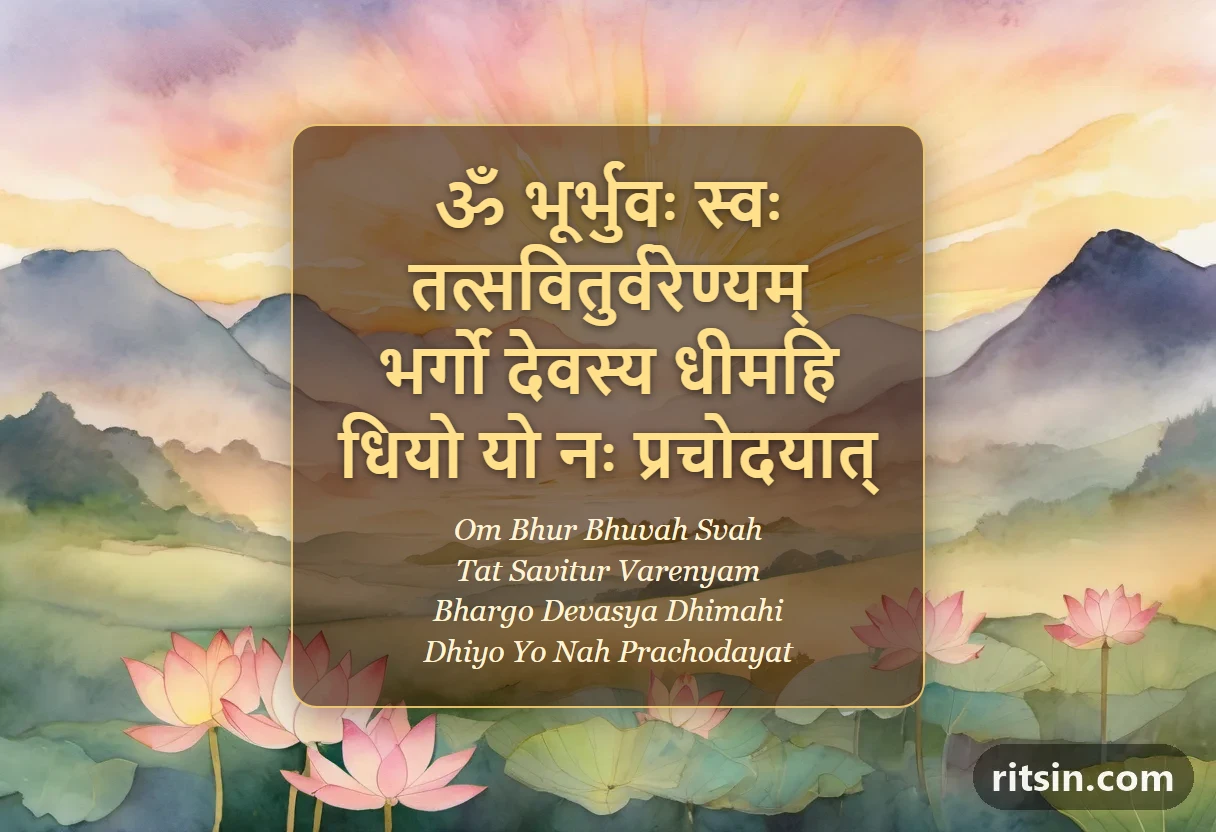
ॐ भूर्भुवः स्वः तत्सवितुर्वरेण्यं । भर्गो देवस्य धीमहि, धियो यो नः प्रचोदयात् ।
Aum Bhur Bhuvah Svah Tat-Savitur-Varenyam Bhargo Devasya Dheemahi Dhiyo Yo Nah Prachodayat
At dawn, before the town wakes up, someone stands facing the east with folded hands and murmurs these lines. The Sun has not yet cleared the horizon. This is how the Gayatri Mantra has been spoken for thousands of years.
The Gayatri Mantra is a verse from the Rigveda (3.62.10) that asks the Sun, as the divine light of Savitr, to inspire our intellect. It is called the mother of all mantras because it is considered the essence of the Vedas, and it is also known as Guru mantra, Savitri mantra, Maha mantra, Veda sara and Veda mata.
Who revealed the Gayatri Mantra?
It is believed that the Gayatri Mantra was revealed to Brahmarshi Vishwamitra, who is also credited as the seer of the third book of the Rigveda. If you want to read about this sage, see The love story of Vishwamitra and Menaka.
The mantra is addressed to the energy of the Sun (Savitr, or Surya). It is in the Gayatri metre, which has three lines of eight syllables each, 24 syllables in all. The opening “Om bhur bhuvah svah” is added before it.
When to chant the Gayatri Mantra
Traditionally it is chanted at dawn, noon and dusk, the three sandhya times. Devotees say that chanting it leads to wisdom and illuminates deeds. But we do not have to be bound by these three periods. It can be chanted any time and anywhere, and the person chanting should keep the heart pure.
After chanting, we repeat “shanti” three times, for peace of body, mind and soul.
The three parts of the Gayatri Mantra
The mantra has three parts:
(1) Praise to Savita: the Divine is first praised.
(2) Meditation or dhyaan on Savita: the Divine is then meditated upon.
(3) Prayer or prarthana to Savita.
The first nine words, “Om Bhur Bhuvah Svah, Tat Savitur Varenyam, Bhargo Devasya”, describe the attributes of the Divine. “Dheemahi” pertains to meditation. “Dhiyo yo nah prachodayat” is the prayer to God to confer on us all powers and talents.
Gayatri Mantra meaning in English
The first line, Bhur Bhuvah Suvah, depicts the unity of body, mind and soul. The second line, Bhargo Devasya Dheemahi, asks to throw away the darkness. The last line, Dhiyo yo nah Prachodayat, means: let the effulgence of the Divine dispel the darkness of ignorance.
In one sentence: may the Sun illumine our intellect in the same way he sheds his effulgence.
Gayatri Mantra meaning in Hindi
उस प्राणस्वरूप, दुःखनाशक, सुखस्वरूप, श्रेष्ठ, तेजस्वी और देवस्वरूप परमात्मा को हम अपने अंदर धारण करें। वह परमात्मा हमारी बुद्धि को सही मार्ग पर प्रेरित करे। यह मंत्र का प्रचलित हिंदी भावार्थ है।
Word by word meaning of the Gayatri Mantra
Aum means Parabrahman. Bhur is the physical world, Bhuvah the mental world and Suvah the spiritual world.
Tat means That. Savitur is the Sun who is Creator and Preserver. Varenyam is adorable.
Bhargo means illumination. Devasya is Divine Grace. Dheemahi: we meditate upon.
Dhiyo means understanding or intellect. Yo means who. Nah means our. Prachodayat means enlighten, guide or inspire.
Gayatri, Savitri and Saraswati
Gayatri has three names: Gayatri, Savitri and Saraswati. Gayatri is master of the senses, Savitri is master of prana, and Saraswati is the presiding deity of speech. These three represent purity in thought, word and deed.
The Gayatri Mantra is also the name of the goddess Gayatri, to whom the metre and the mantra belong. For Saraswati, see Saraswati puja, the festival to celebrate learning.
The five faces of Gayatri
In the devotional tradition, Gayatri is said to have five faces and is hence called Panchmukhi. This is a devotional tradition and not a feature of the Vedic verse itself.
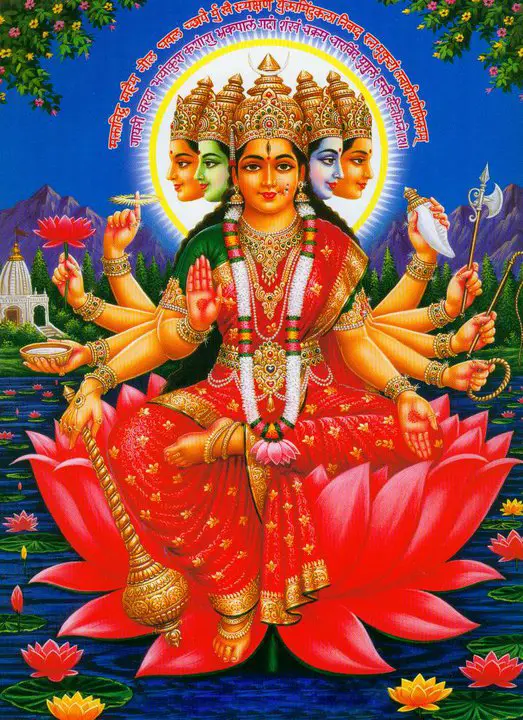
Om (Pranava) is the first face (the Pranava principle represents 8 different forms of wealth). Bhur Bhuva Svah is the second face. Tat Savitur Varenyam is the third. Bhargo Devasya Dheemahi is the fourth. Dhiyo yo nah prachodayat is the fifth.
All five aspects of the Gayatri Mantra are within us. The mantra teaches us to achieve harmony in thought, word and deed.
What devotees say about Gayatri
Devotional titles describe Gayatri as the reliever of all disease (Sarva roga nivarini), the fulfiller of all desire (Sarva vancha phalashi), the one who wards off misery (Sarva dukha parivahini), and the bestower of all that is beneficial.
Devotees say that chanting illuminates the mind, calms a disturbed mind, and helps one cultivate determination, self-esteem and inner peace. These are statements of faith and experience. They are not medical claims, and chanting is not a substitute for treatment.
For other mantras, read The most important mantras and their significance, Om (Aum) and Maha Mrityunjay Mantra.
Questions readers ask
What is the Gayatri Mantra?
A verse from the Rigveda (3.62.10) addressed to Savitr, the Sun, praying for the inspiration of our intellect.
How many times should the Gayatri Mantra be chanted?
The Rigveda verse fixes no number. Many devotees chant it with a 108-bead mala, but the count is a matter of tradition and personal practice.
गायत्री मंत्र कौन सा है और उसका अर्थ क्या है?
“ॐ भूर्भुवः स्वः तत्सवितुर्वरेण्यं भर्गो देवस्य धीमहि धियो यो नः प्रचोदयात्” ऋग्वेद (3.62.10) का मंत्र है। इसका अर्थ है कि हम उस देव सविता के तेज का ध्यान करते हैं, जो हमारी बुद्धि को सही दिशा में प्रेरित करे।
Sources and versions
Rigveda 3.62.10, the Gayatri metre, Vishwamitra as the seer and the three sandhya times are from the Wikipedia entry Gayatri Mantra. The word meanings, the five faces and the devotional titles are traditional glosses from the author’s earlier text; translations differ between teachers. The statement that this is the “oldest” mantra is a popular belief that is not claimed by the Vedic text itself.