
Lok Sabha 2014, Varanasi: Narendra Modi (BJP) won the seat with 5,81,022 votes. Arvind Kejriwal (AAP) came second with 2,09,238 and Ajay Rai (Congress) third with 75,614, a margin of 3,71,784 votes. Before the result, social media was one way people tried to guess who was ahead, and this post looks at one free tool that tried to measure it.
Lok Sabha 2014 Varanasi: the battle of titans
In March 2014 the Indian political scene was heating up, and there was a lot of buzz on social media. A TV channel said that, as per a study, about 160 Lok Sabha seats would be influenced by social media in this election. It was natural to ask how the leaders were faring there. So far, we only heard how active someone was, or how many conversations were going on.
Varanasi became the seat everyone watched. Modi had chosen the city, and Kejriwal chose to stand against him. A case study called The battle of titans by the firm Ranfor looked at their chances online. (Its website has since gone offline, so the original links are no longer given here.)
Pulse: a free app that scored leaders on social media
There was no single holistic view which could truly measure popularity. A free Android application, “Pulse”, offered exactly that: one single view of a leader’s popularity, with a score you could monitor on any Android device. The app is no longer available.
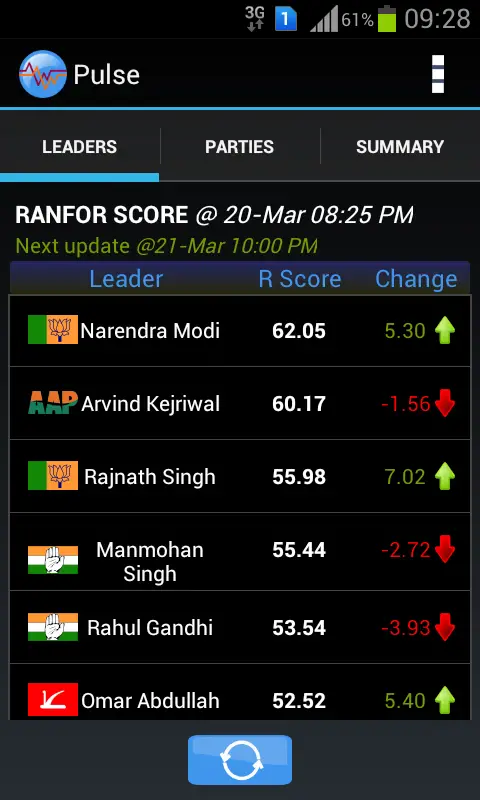
Who topped the social media chart in March 2014
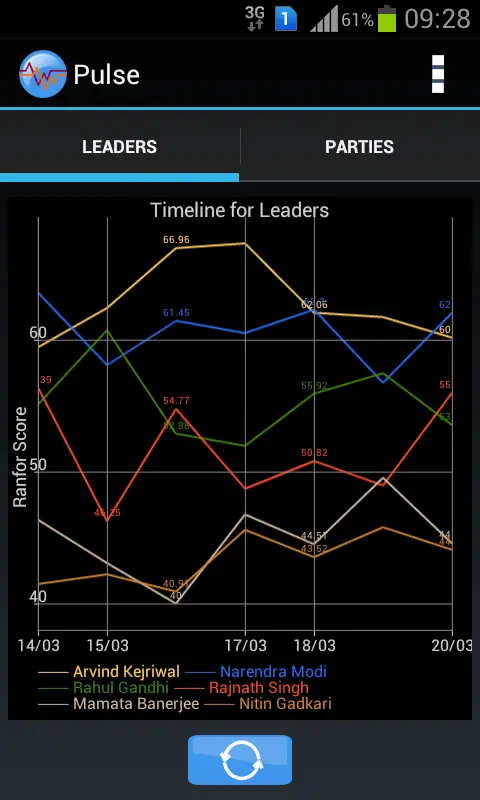
The app gave popularity scores and showed how much a leader’s score had gone up or down from the previous period. It captured sentiment well. The day a video of Arvind Kejriwal and Punya Prasoon Vajpayee went viral, there was a sharp drop in Kejriwal’s popularity score.
The app showed Arvind Kejriwal and Narendra Modi as the leaders on social media, while Rahul Gandhi was not necessarily at third place. It also showed some not-so-obvious names, such as Rajnath Singh, well ahead of other national figures, which suggested that his social media campaign was managed well.
What happened in Varanasi: the 2014 result
Varanasi voted on 12 May 2014 and the votes were counted on 16 May. Modi polled 56.37 per cent of the votes cast; Kejriwal got 20.30 per cent and Ajay Rai 7.34 per cent. Turnout was 58.35 per cent of 17,67,486 registered voters.
So the social media buzz, where Kejriwal often led, did not turn into votes in the city. Online popularity and the ballot box measured different things.
Questions readers ask
Who won Varanasi in the 2014 Lok Sabha election?
Narendra Modi won by 3,71,784 votes over Arvind Kejriwal.
Who contested against Modi in Varanasi in 2014?
The main rivals were Arvind Kejriwal of the Aam Aadmi Party and Ajay Rai of the Congress.
2014 लोकसभा चुनाव में वाराणसी से कौन जीता?
नरेंद्र मोदी (भाजपा) 5,81,022 वोट पाकर जीते। अरविंद केजरीवाल (आप) को 2,09,238 और अजय राय (कांग्रेस) को 75,614 वोट मिले।
Varanasi is also the city of Shiva’s Jyotirlinga; read about Kashi Vishwanath and the Sankat Mochan Hanuman temple.
Sources
Result figures: Wikipedia, Varanasi Lok Sabha constituency (Election Commission data). Counting-day report: Business Standard/IANS, 16 May 2014. The app scores quoted above are the author’s March 2014 observations.