
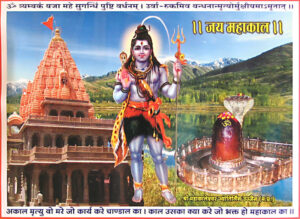
Mahakal, or Mahakaleshwar, is Lord Shiva as the Lord of Time and Death, worshipped in the ancient city of Ujjain in Madhya Pradesh. The Mahakaleshwar temple is one of the twelve Jyotirlingas of India, and its Shivling is believed to be swayambhu, self-arisen. This is the fierce form of Shiva that came to save his devotees when a demon attacked Ujjain, then called Avanti.


Who is Mahakal? Shiva as the Lord of Time
Lord Shiva is worshipped as Mahakala here. The word kala means both time and death, so Mahakal is the one who rules both. This form of Lord Shiva is fierce, beyond imagination and description. Yet before his true devotees Shiva is always Bholenath, who is easily pleased.
An interesting story explains how this form came to Ujjain. It took place when Ujjain was known as Avanti, and it is told in the Shiva Purana (Koti Rudra Samhita, chapters 16-17).
The story of Mahakala: how Shiva came to Avanti
Once there lived a pious man in Avanti (nowadays Ujjain) who was an ardent devotee of Lord Shiva. He had four sons and the family worshipped Lord Shiva daily. Not far from their home, on a hill named Ratnamala, lived an asura (demon) named Dooshana.
Dooshana hated all forms of Shiva and Vedic worship. He went around killing people who worshipped Shiva. Soon he came to know about the family in Avanti that worshipped Lord Shiva.
The demon at the door
He arrived with his army and attacked the city. But the family continued to worship Shiva in the form of a Shivling. Finally the demon and his soldiers reached the home of the pious man and started hurling weapons. The demon broke open the door and advanced towards the Shivling, raising a sword.
The dreadful form that rose before the Shivling
Suddenly there was a deafening sound, and a dreadful form beyond explanation appeared before the Shivling. A single glance of the Mahakala form of Shiva burned the demon and his army to ashes. Uncontrollable and unsatisfied, the form gave a huge roar and the entire universe trembled in fear.
But the family was delighted to see Lord Shiva and continued chanting his glory and prayers. Hearing the prayers of his devotees, his anger subsided.
Why Shiva stayed in Ujjain as Mahakal
The family, aware of the dangers of the world, realized that the form of Shiva as Mahakala was essential for peace and prosperity. They asked him to reside in this form at Ujjain. Since then Shiva remains at the Ujjain Mahakala temple as Mahakala, the one with the power to annihilate all living and non-living.
Another legend of Mahakal: King Chandrasena and the boy Shrikhar
In another popular retelling, the city of Ujjain was called Avantika and was famous for its beauty and as a centre where students went to study the scriptures. A pious king named Chandrasena ruled it and worshipped Shiva all the time. One day a farmer’s boy named Shrikhar heard the king chant the Lord’s name and rushed to the temple to pray with him. The guards removed him by force and sent him to the outskirts of the city near the river Kshipra.
When the kings attacked Ujjain
Rivals of Ujjain, King Ripudamana and King Singhaditya of the neighbouring kingdoms, decided to attack and take over its treasures. Hearing this, Shrikhar started to pray. The news spread to a priest named Vridhi, who was shocked and, on the urgent pleas of his sons, began to pray to Lord Shiva at the Kshipra.
The kings attacked and were successful, with the help of the powerful demon Dushan, who had been blessed by Lord Brahma to be invisible. They plundered the city and attacked the devotees of Lord Shiva.
Shiva appears as Mahakala
On hearing the pleas of his helpless devotees, Lord Shiva appeared in his Mahakala form and destroyed the enemies of King Chandrasena. At the request of Shrikhar and Vridhi, he agreed to reside in the city, become the chief deity of the kingdom and protect all his devotees.
From that day Shiva has resided in his light form as Mahakala in a Lingam that formed on its own from the powers of the Lord and his consort Parvati. He blessed his devotees and declared that those who worship him in this form would be free from the fear of death and disease, and would be granted worldly treasures and his protection.
Facts about the Mahakaleshwar temple
One of the oldest places of pilgrimage, the temple finds mention in ancient texts and has been praised by the great Sanskrit poet Kalidasa in the Meghaduta. The Mahakaleshwar temple, with its astonishing architecture, dominates the skyline of Ujjain. The lingam at this shrine is believed to be swayambhu (self-arisen).
The south-facing Shivling
The idol of Mahakaleshwar is known to be dakshinamurti, which means it faces the south. This is a unique feature: the tantric Shivnetra tradition holds that among the twelve Jyotirlingas, only Mahakaleshwar is south-facing.
Inside the temple
The idol of Omkareshwar Mahadev is consecrated in the sanctum above the Mahakal shrine. The images of Ganesh, Parvati and Kartikeya are installed in the west, north and east of the sanctum sanctorum. To the south is the image of Nandi, the vehicle of Lord Shiva. The idol of Nagchandreshwar on the third storey is open for darshan only on the day of Nag Panchami. The temple has five levels, one of which is underground.
The courtyard and the spire
The temple is in a spacious courtyard surrounded by massive walls, near a lake. The shikhar, or spire, is adorned with sculptural finery. Brass lamps light the way to the underground sanctum. It is believed that prasada offered here to the deity can be re-offered, unlike at other shrines.
Bhasma Aarti at Mahakaleshwar
One of the most important rituals of Mahakaleshwar is the Bhasma Aarti. The temple opens in the morning at 4 AM with this special aarti, performed with sacred ash (bhasma). Since ancient times, the bhasma used to be fresh, hot ash from a funeral pyre, since Lord Shiva is believed to live in and enjoy the cremation ground. Now the temple has changed its ways, and the aarti is performed with bhasma made from cow dung, what we call Vibhooti.
People who saw the original aarti, which was performed until about 15 years ago, say it was a different experience that cannot be recreated. The present aarti is also a grand experience. Read more about the Mahakal Bhasma Aarti and the Mahakal shringar.
Questions readers ask
Why is Mahakal called Mahakal?
Mahakal means the Great Time or the Lord of Death (kala means time and death). Devotees see Shiva here as the one who is above death, which is why the Shiva Purana story has him burning a demon with one glance.
Which Jyotirlinga is Mahakaleshwar?
It is one of the twelve Jyotirlingas of Shiva and the only one that faces south, by the Shivnetra tradition. It sits on the bank of the Kshipra river in Ujjain, Madhya Pradesh. Read about the other Jyotirlingas such as Omkareshwar.
महाकाल कौन हैं?
महाकाल भगवान शिव का वह रूप हैं जो काल (समय और मृत्यु) के भी स्वामी हैं। उज्जैन में महाकालेश्वर ज्योतिर्लिंग बारह ज्योतिर्लिंगों में से एक है। शिव पुराण की कथा के अनुसार शिव ने दूषण नामक असुर से भक्तों की रक्षा करने के लिए यह रूप लिया और उज्जैन में विराजमान हुए।
Sources and versions
Shiva Purana, Koti Rudra Samhita, chapters 16-17 (the Vedapriya and Dushana story). The Chandrasena and Shrikhar legend is a popular retelling and its details vary between tellers. Check temple timings on the official temple website before travelling.
Very nice Article on Lord Shiva
Thanks, there are more articles on Jyotirlingas.