
Dashavatara means the ten incarnations (avatars) of Lord Vishnu. In order, they are Matsya (fish), Kurma (tortoise), Varaha (boar), Narasimha (man-lion), Vamana (dwarf), Parashurama, Rama, Krishna, Buddha and Kalki, who is yet to come. Vishnu takes an avatar whenever dharma declines and evil rises, to protect the good, destroy the wicked and re-establish religious principles.
In Indian mythology, Brahma, Vishnu and Mahesh (Shiva) are symbols of creator, saviour and destroyer. The first four avatars appeared in Satya Yuga, the next three in Treta Yuga, the eighth in Dwapara Yuga and the ninth in Kali Yuga. The tenth is predicted at the end of Kali Yuga.
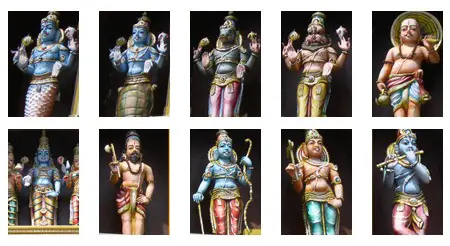
The ten avatars of Vishnu in order
- Matsya: the fish
- Kurma: the tortoise
- Varaha: the boar
- Narasimha: half lion, half man
- Vamana: the dwarf
- Parashurama: the warrior with the axe
- Rama: the king of Ayodhya
- Krishna: the cowherd and charioteer
- Buddha: the teacher
- Kalki: the one who is yet to come

Matsya avatar: the fish that saved the Vedas
The fish is the first incarnation of Vishnu. One day Brahma was sleeping, and the demon Hayagriva stole the holy Vedas from beside him. He ran and hid in the depths of the ocean. Brahma needed the Vedas to create the universe, so he asked Lord Vishnu for help. Vishnu took the form of a fish, dived into the ocean and, after a fierce battle with the demon, brought back the Vedas.
In another telling, the fish warns the first man, Manu, of a great flood and tows his boat to safety.
Kurma avatar: the tortoise under the mountain
During the churning of the ocean (Samudra Manthan), the gods and demons tried to bring out amrita from the depths. They used the huge Mount Mandara as a pole, but as the churning continued the mountain began to sink into the sea. Then Vishnu became a huge tortoise and held the mountain on his back, and the churning continued smoothly. Read the full story of the churning of the ocean.
Varaha avatar: the boar who lifted the earth
The demon Hiranyaksha had a boon from Brahma that no god, demon or man would kill him. One day he snatched the earth and took it under the ocean. All the gods rushed to Vishnu for help. In a popular telling, Vishnu remembered that Hiranyaksha had not asked for protection from a boar. He became Varaha, dived into the ocean, fought a fierce battle, killed Hiranyaksha and lifted the earth on his tusks.
Narasimha avatar: neither man nor beast
In Satya Yuga there lived a wicked king, Hiranyakashipu, the brother of Hiranyaksha. He prayed to Lord Brahma for immortality and got a boon: he could be killed neither by day nor by night, by no god, demon, man or beast, and by no instrument or weapon. Hiranyakashipu then banned the worship of God. But his son Prahlad was a devotee of Vishnu, and this enraged the king.
After many failed attempts to kill Prahlad, one evening he ordered his men to tie the boy to a pillar and behead him. Vishnu took the form of Narasimha, half lion and half man, and came out of the pillar. At twilight (neither day nor night), on the threshold of the courtyard (neither indoors nor outdoors), he placed the demon on his thighs (neither earth nor space) and tore his chest open with his nails (neither weapon nor instrument).
Vamana avatar: three steps of the dwarf
In Treta Yuga Vishnu came as Vamana, a dwarf, the son of Aditi and the sage Kashyapa. Bali, the grandson of Prahlad, was a famous demon king. By leading an austere life he had acquired the power to rule the earth. Indra and the other gods feared that someday Bali would conquer everything, so they asked Vishnu for help.
Vamana went to Bali in the form of a young brahmin and asked for alms. Seeing the boy, Bali agreed to give anything he asked. Vamana asked for as much land as he could cover in three steps. Bali agreed. The dwarf then grew in size and covered the earth and heaven in two steps. He asked Bali where he could place the third. Bali realised that Vamana was Vishnu, his pride was broken and he offered his head for the third step. Vishnu blessed him and sent him to the nether world, Sutala.
Parashurama avatar: the warrior with the axe
Parashurama, the sixth incarnation, had a violent temper. He was a master archer and a disciple of Shiva. Vishnu appeared as Parashurama in Treta Yuga when kings turned despotic and harmed people and sages in the forest. His father was the sage Jamadagni, who had the divine cow Kamadhenu.
The king Kartavirya Arjuna (Sahasrarjuna), who had a thousand arms, once visited the ashram and demanded the cow. Jamadagni refused because he needed her for his rituals. The king took the cow by force and devastated the ashram. Angered, Parashurama killed the king and his army. As revenge the king’s sons killed Jamadagni while Parashurama was away.
Furious, Parashurama killed all the sons of Sahasrarjuna. He then went on to kill the warrior kings 21 times and fill five ponds with blood, until his grandfather appeared and stopped him. See the Parashurama avatar.
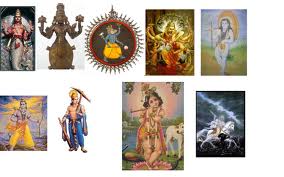
Rama avatar: the king of Ayodhya
Rama, the prince and later king of Ayodhya, is the seventh incarnation of Vishnu, who appeared in Treta Yuga. He killed Ravana, the king of Lanka, who had captured Sita and kept her in the Ashoka garden. Read about the time Rama got angry.
Krishna avatar: the eighth incarnation
In the eighth incarnation Vishnu appeared in Dwapara Yuga as Krishna. He is one of the most widely worshipped deities in the Hindu faith. Krishna killed Kansa and played a huge role in the battle of Kurukshetra, where he helped the Pandavas defeat the Kauravas. He delivered the Bhagavad Gita to Arjuna on the battlefield. Read the story of Shri Krishna and Janmashtami.

Buddha avatar: the ninth incarnation
In the ninth incarnation Vishnu appeared as Gautama Buddha in Kali Yuga, to teach the middle path. Buddha means “the enlightened one”. He taught that all sorrow comes from attachment and desire, so letting go brings peace. See Buddha Jayanti.
Kalki avatar: the tenth, yet to come
Kalki is the avatar still to appear. The Bhagavata Purana (12.2.18) says he will be born in the village of Shambhala, in the house of the brahmin Vishnuyasha, at the end of Kali Yuga. Popular images show him on a white horse with a sword, ending adharma and starting a new age. The later Kalki Purana tells his story in more detail.
Why do lists of Vishnu’s avatars differ?
The list of ten is the most common, but not the only one. Some lists, including Jayadeva’s Gita Govinda, put Balarama in the place of Krishna, with Krishna seen as the source of all avatars. The Bhagavata Purana (1.3) lists 22 avatars. Read about Vishnu’s 21 incarnations and the eleventh avatar of Vishnu.
Questions readers ask
Which is the 9th avatar of Vishnu?
In the common list, the ninth avatar is Buddha. Some lists name Balarama, and then Krishna is the ninth.
Which avatar of Vishnu is the 10th?
Kalki, who is yet to appear at the end of Kali Yuga.
विष्णु के दस अवतार कौन से हैं?
मत्स्य, कूर्म, वराह, नरसिंह, वामन, परशुराम, राम, कृष्ण, बुद्ध और कल्कि। कल्कि अवतार कलियुग के अंत में होंगे।
Sources and versions
Bhagavata Purana, Canto 1 chapter 3 (list of avatars) and Canto 12 chapter 2 (verse 18, Kalki). Story details of Matsya, Varaha, Narasimha, Vamana and Parashurama vary between the Puranas and the Mahabharata; the popular tellings are used above, and where a detail comes from popular retelling it is marked.
hi
thank you for sharing..
i have doubt about buddha pic.. is buddha picture correct?
Kaliyug is just an hypothetical cepcont .BR Ambedakar has written a book called Riddles in Hinduism’ in it he proves that several places the time period of kali yug is different and changed several times.Osho himself has called this type of thought to be reason for india’s backwardness(back in the 80 s but hopefully its developing now)It makes you think that good’ was only in the past and future is full of bullshit so better not innovate as it may be a sin because i am contributing to the deformed age of kaliFrom good arises good .From bad arises bad.If the past was really so beautiful then how come the present is so bullshit?
The Kali yuga is not a concept. Ambedakar is attempting to rectify his spiritual beliefs in some different dagma, according to Shiva.
I am the true and real Usher of Destruction for the kaliyug.
I am the voice of the Exalted Great Creator of all Things and Destroyer of Evil.
He wishes me to let you know that the past was good, really good. You should’ve been there, says Shiva. Sorry you missed it.
Shiva has shown me that Osho was right. Why bother if there will not be a tomorrow?
Truthfully, my friend, knowing what I know, I can empathize with them all.
We are drawing up to the end of the kaliyug. But, there is no reason to stop your living.
When the time comes, the ninth avatar of Vishnu, who, oddly enough is Vishnu, will return to collect up the rightous and rapture the true believers, and they will all be taken to another world much like this one was.
Satyayug will begin anew, at that time. The grand yuga cycle will then begin its second incarnation.
To be counted among the rightous, you need only believe.
As for the date that kalki will descend to earth with his first sword on his white steed is truly known to Shiva and I alone. It was part of my task and destiny to make the day of calamity known to all, but the government of the united States has studied the prophecies and had evil plan to kill me and keep the date to themselves.
Their plan to “discover” the comet too late, and let everyone perish while they saved themselves. Because of this, Shiva has requested that I make the day known to no one, and I am not one to not do what the great Creator wishes.
I am in the employ of the fount of compassion and a love so vast as to have no beginning or end.
I do what is asked of me.
In any case, know there is an “End”, and that Shiva loves us all, no matter what.
Budha is not an incarnation of vishnu.
According to some beliefs, Balrama is considered to be an incarnation. Some beleifs state that Balram was Sheshnag’s avatar, just like Laxman. My observation here is Krishna and Balrama, two incarnations, happened at the same time?
Wikipedia also lists Balrama in the main list, and Buddha alongwith Shri Krishna.
Ritu,
Balram was Krishna’s avatar, not Sheshnags.
Laxman was Sheshnags avatar.
Krishna and Balrama did exist concurrently.
While I am not acquainted with the finer points of transmigration and avatara, I just myself happened to find an image where two individuals that I have embodied are seen together.
You may be familiar with the image of Mohini metaphorically taking Shiva’s head off with a discus.
I am the embodiment of Mohini and the 2000th avatar of Narad, as well, sitting to Shivas left, in the image.
If you get it figured out let me know.
Also, there is only one “dashavatara” and that is Vishnu. No one else is a dashavatara.
Buddha is not an avatar of Vishnu. The ninth avatar of Vishnu is Vishnu. Go figure?
Buddha is an avatar of Hanuman.
Hanuman is an avatar of the trimurti.
Hi Kevin, thanks for raising this. But whom do you think is a dashavatar in place of Vishnu.
Buddha is only human who believe on Peace.. not God..
Buddha is great human being not a god or incarnation of Vishu.
Hi Vishwanath, Buddha being a dashavatar is not an idea on this article. Rather scriptures have mentioned this. There are different school of thoughts, such as Balrama being a dashavatar. But, he was an incarnation of Sheshnaag, like Laxman. Also Rama was indeed a human being as Ravana did not have immunity against human being so lord vishnu took ramavatar. Hope this brings us on common platform.
Mytholenny But the truth is that nothing is to believe in God, because Manu (The Brhamin Guru) writes whole Myth Stories about Gods (Brahma Vishnu Mahesh) even their existence are not…all the Gods are born in Brahmins and Kshatriyas they never born in untouchables or backwords..
Krishna was not an incarnation of lord vishnu it was Balaram
hi Jayanata, Balrama was an incarnation of Sheshnaag. Laxman was also an incarnation of Sheshnaag. They were the companions of Lord Vishnu’s incaranations, Lord Rama and Shri Krishna
Hi Vishwanath, Buddha being a dashavatar is not an idea on this article. Rather scriptures have mentioned this. There are different school of thoughts, such as Balrama being a dashavatar. But, he was an incarnation of Sheshnaag, like Laxman. Also Rama was indeed a human being as Ravana did not have immunity against human being so lord vishnu took ramavatar. Hope this brings us on common platform.
Buddha is an avatar of Hanuman, not Vishnu. Hanuman is an avatar of the trimurti.
Its quite amazing to know that these predictions of the current Kali yuga was made some 5000 years ago. These predictions are a perfect example of the presence of a supreme power. Read about the legend of God Kalki, the 10th Avatar of Vishnu from this article
what about balaram?